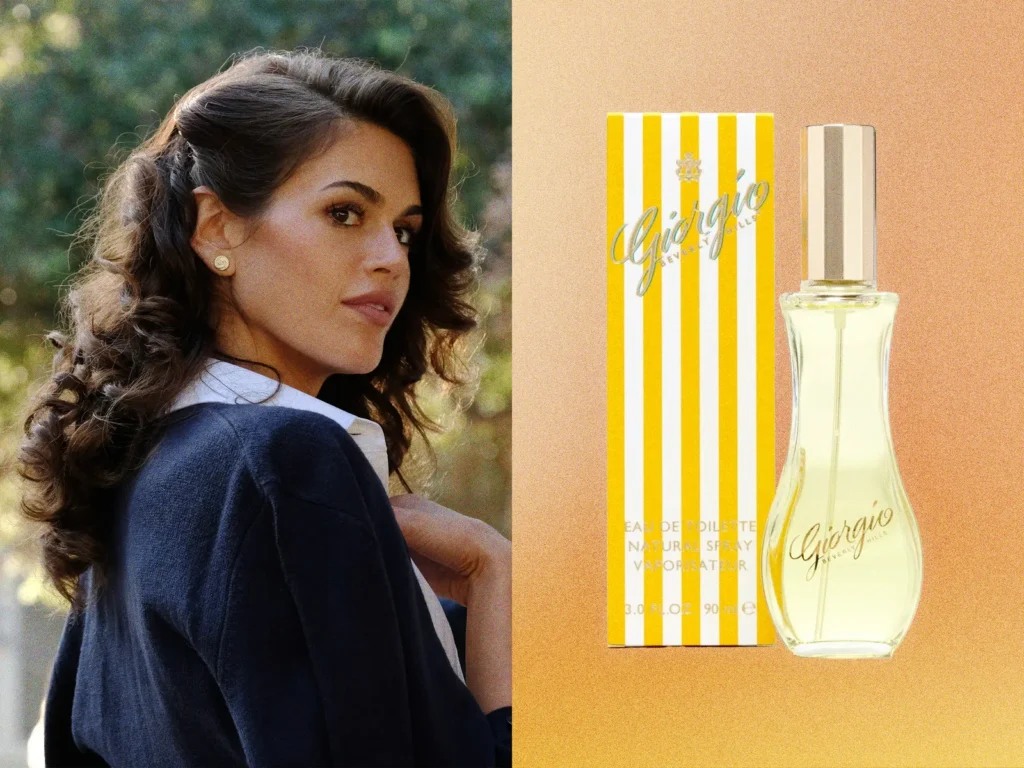
In the most recent episode of The Shards, Ryan Murphy’s flashy adaptation of the Bret Easton Ellis novel, a suggestive gift fuels murder suspicions. In the two-parter “Homecoming” (spoilers ahead), slick new kid in school Robert Mallory (Homer Gere) gives Susan Reynolds (Kaia Gerber) a bottle of eau de toilette in his ongoing quest to woo her away from her boyfriend. Reynolds gasps as she peels away the wrapping paper, exposing the canary-yellow and white striped packaging of Giorgio Beverly Hills beneath it. “Robert!” she squeals. “Giorgio is not cheap.” To that, Mallory coos: “Neither are you.”
Money is hardly a concern for Reynolds, Mallory, and the other privileged San Fernando Valley teenagers populating Ellis’ murder mystery, set at a moment when Aqua Net and conspicuous consumption reigned. In 1981, when The Shards is set, only a lucky few could nab bottles of the real-life Giorgio upon the fragrance’s release; back then, it was sold exclusively at the brand’s famed Rodeo Drive boutique. By giving Reynolds a coveted bottle of Giorgio in those early days, Mallory was really gifting her something else: A confirmation of status within the upper echelon of society. “Giorgio was something to aspire to,” says Jode S. Mann, a prop master on The Shards who grew up in the Valley. “If I could only afford Giorgio, then that would make a statement about who I was, and who I was interpreted as when I walked into a room.”
But Giorgio also takes on another, darker significance in Murphy’s show. A serial killer known as the Trawler, who is currently at large and terrorizing the community with a string of gruesome murders, has left behind one survivor, Rhonda. She remembers nothing about her traumatic abduction except how the perp smelled — and it’s implied that they smelled like Giorgio. The reveal means that anyone with access to such a luxury, including some of the show’s main characters, and their parents, could be the Trawler. Then again, as The Shards makes clear with its frequent inclusion in the show, for a certain subsection of Los Angeles high society, Giorgio was just in the air back then
The Shards’ period-perfect use of Giorgio Beverly Hills illustrates how wealth has transformed from a brash signifier into something quieter — a shift personified by the eponymous boutique that sold it and, in the process, transformed luxury retail into a seductive experiential affair. Instead of recalling a delicate floral bouquet, Giorgio—with its notes of tuberose and orange blossom—was practically “death by flowers,” says perfumer and writer Victoria Belim-Frolova. Its brazenness would help it become “arguably the most successful scent of the decade,” as the LA Times wrote. “It really started the whole trend for a big, loud perfume that announces your presence, and unapologetically so,” says Belim-Frolova.
When Giorgio Beverly Hills opened on Rodeo Drive in 1961, the street had not yet acquired its now-longstanding reputation as a shopping destination for the well-heeled. If anything, its small businesses — tailoring, a toy store, a gas station, a furrier — catered more to neighborhood residents. Giorgio zagged by putting up a huge yellow and white striped awning outside of its vaguely European-sounding boutique. As Steve Ginsberg wrote in his book Reeking Havoc: The Unauthorized Story of Giorgio, it was “an “eclectic little store [that] combined Fred’s continental formality with Gale’s funkiness.” Business struggled in the early days. But then Fred Hayman, a former manager at the Beverly Hilton and the Waldorf who co-owned the store with his then-wife, Gale, began selling a navy menswear-tailored jacket worn by Jacqueline Onassis, and the boutique.
When the Haymans remodeled and expanded the store in 1969, Giorgio became less a retailer and more akin to “entering the home of a wealthy man,” as Ginsberg writes. The couple installed a pool table in the middle of the store, a first for a boutique. Shoppers could have a tipple or a coffee there. Bookshelves lined the store, and a nook had a fireplace where visitors could put their feet up; accordingly, Giorgio became an offsite office for Hollywood types. Following Giorgio’s wild success, other boutiques offering a luxury “experience,” like Bijan, began springing up on Rodeo Drive.
According to Ginsberg’s book, Gale saw an opportunity to get into the fragrance game, and convinced Fred to begin testing scents. It was a gamble. As retailers, how much could they really scale a fragrance to other retailers and competitors? Gale’s answer: Keep going bigger, making the top note of the perfume even more noticeable — a turn away from scents of the 1970s, which tended to be woodsy and mossy, says Belim-Frolova. Ginsberg notes in his book that Gale refused to compromise on keeping significant doses of natural ingredients like absolute rose and absolute jasmine in the perfume; the curved bottle was inspired by Tiffany’s Baccarat bud vases, as well as the lineage of Phoenician and Mandarin pottery. The packaging recalled Giorgio’s unmistakable yellow and white awning, and the price was notably steep—$150 an ounce, or about $550 in today’s dollars, higher than comparable luxe offerings of the day like Yves San Laurent’s Opiumu.
In early 1982, Giorgio began advertising in national magazines using scent strips —the first fragrance to ever do so—and became a cultural phenomenon beyond LA. Soon tourists began pouring into Giorgio to get their own bottles. When retailers like Bloomingdales began stocking it, Giorgio “was starting to approach the volume figures of premier cosmetics and treatment lines such as Estée Lauder and Clinique,” Ginsberg writes. “Suddenly the entire fragrance category was being looked at differently.” By 1985, Giorgio was everywhere — “even Michael Jackson wears it,” the New York Times wrote. “It has become so recognizable that doormen and cab drivers have been known to call out ‘’Giorgio’ when women wearing it walk by.”
Belim-Frolova notes that Giorgio was intentionally boisterous. One spritz was all it took for it to be enveloped in a “cocoon of scent,” as she puts it, that might need a few showers to wash off completely. The smell became so overpowering that some restaurants and hotels enforced an unofficial “no Giorgio” rule back then. But Giorgio’s iron grip on culture wouldn’t last past the ‘80s. The Haymans went through a messy divorce in the public eye and, in 1987, sold Giorgio to Avon for over $165 million. By the early ‘90s, Giorgio Beverly Hills fever had given way to more watery and elegant scents, like Giorgio Armani’s Acqua di Giò. “Basically, the very qualities that made it so appealing in the ‘80s, in the ‘90s, make it seem a little bit outdated,” says Belim-Frolova.