For generations, Saks Fifth Avenue represented the pinnacle of American luxury shopping. Known for its designer collections, exceptional service, and glamorous flagship store in Manhattan, the retailer built a reputation as a destination where shoppers could discover the world’s most coveted fashion and accessories. But mounting debt, declining inventory, unpaid suppliers, and a troubled acquisition strategy have brought the historic department store to a defining crossroads.
Saks Global, the parent company that brought together Saks Fifth Avenue, Neiman Marcus, and other luxury retail businesses, filed for bankruptcy protection in January 2026 with approximately $3.4 billion in debt. Although the company emerged from Chapter 11 restructuring in June under a new name, Exemplar Luxury Group, questions remain about whether Saks can restore its reputation and regain the confidence of shoppers and designers.

Donatella Versace signs autographs at a 1996 fragrance event.Photo by Robert Mitra/WWD/Penske Media via Getty Images
When Saks Fifth Avenue Defined American Luxury
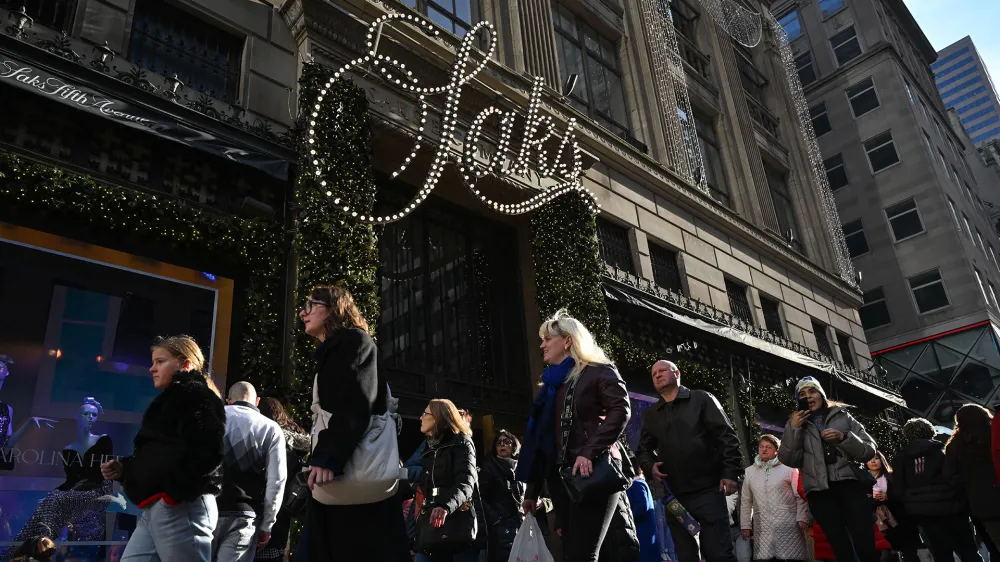
Founded on the principle that shopping should be an experience in itself, Saks Fifth Avenue became synonymous with sophisticated fashion and premium customer service. Its Manhattan flagship, which opened in 1924, developed into a landmark for both New Yorkers and international visitors.
The retailer’s appeal extended well beyond its location. Its merchandise included collections from major fashion houses such as Armani, Zegna, Dior, Chanel, Gucci, and Louis Vuitton, alongside established American designers and Saks’ own private-label products.
Customers could find everything from evening gowns and luxury handbags to tailored suits, fine fragrances, cashmere knitwear, and leather accessories. For shoppers accustomed to having multiple prestigious brands under one roof, Saks offered convenience without sacrificing exclusivity.
Footwear became one of the store’s most celebrated categories. Its enormous designer-shoe department was so influential that the United States Postal Service recognized it in 2007 with a dedicated ZIP Code designation: 10022-SHOE.
For longtime customers, the appeal was about more than the merchandise. Knowledgeable sales associates, carefully curated selections, and the atmosphere of the flagship helped distinguish Saks from ordinary retailers.
As New York brand strategist Julia Stedman, a longtime customer, recalled, Saks was the dependable destination where shoppers could find virtually every luxury brand they wanted.
That reputation made the retailer’s subsequent decline particularly striking.

In 2007, a customer photographs heels on 10022-SHOE, the designer-shoe floor so massive it was given its own zip code.Photo by Timothy A. Clary/AFP via Getty Images
How the Shopping Experience Began to Deteriorate
In the years leading up to bankruptcy, customers increasingly encountered sparse shelves, incomplete clothing collections, and limited choices in departments that had once been central to the Saks experience.
Former employees described growing frustration among shoppers, many of whom questioned whether the stores were preparing to close. Some locations began to resemble discount outlets rather than the polished luxury environments customers expected.
The problems extended to product availability. Sales associates reported receiving incomplete size ranges and going months without full deliveries of certain collections. For designers and beauty companies, the deteriorating retail environment made it increasingly difficult to present their products as intended.
Anita Berger, a former senior salesperson at Saks Fifth Avenue in St. Louis, said customers noticed the difference immediately. The store had once maintained a loyal following for decades, but its shrinking assortment and lack of new merchandise undermined that relationship.
The wider retail landscape was also changing. Online shopping, direct-to-consumer websites, resale platforms, and social media had transformed how customers discovered and purchased luxury goods. The traditional department-store model, built around expansive floors filled with merchandise, was under pressure.
However, industry observers argue that these structural challenges do not fully explain Saks’ financial collapse. The company’s debt burden, management decisions, and relationships with suppliers played a significant role.

At Saks, the merchandise was only part of the attraction. Above: A family-clothing display fills its store at the American Dream mall in New Jersey; architect Rem Koolhaas’s kaleidoscopic escalators bring design drama to the Manhattan flagship.George Chinese/WWD/Alamy
The Neiman Marcus Acquisition and a Growing Debt Burden
One of the most consequential decisions was Saks Global’s acquisition of Neiman Marcus, completed in December 2024. The transaction combined Saks Fifth Avenue, Neiman Marcus, Bergdorf Goodman, and several related retail businesses under one corporate structure.
The deal was intended to strengthen the combined luxury retail operation. Instead, it intensified concerns about the company’s finances and ability to pay suppliers.
Saks had already accumulated substantial debt before the acquisition. Its financial history included the 2013 purchase by Hudson’s Bay Company, the former Canadian retailer, as well as a mortgage on the Saks Fifth Avenue flagship worth approximately $1.2 billion in 2014.
Other transactions added complexity. In 2016, Saks acquired the off-price shopping platform Gilt Groupe for $250 million, later selling it again for an undisclosed sum.
These obligations placed additional pressure on cash flow as the business attempted to finance its operations and meet its commitments to brands.
Lorenzo Marinuzzi, a partner at Morrison Foerster representing unsecured creditors, noted that Saks had inherited financial obligations connected to Hudson’s Bay Company. The company’s decision to continue servicing those obligations while vendors waited for payment contributed to frustration across the fashion industry.
Hudson’s Bay Company itself filed for bankruptcy in 2025 and eventually closed its stores, adding another chapter to the retailer’s troubled history.
Management Decisions Under Scrutiny
Richard Baker, the former Hudson’s Bay Company executive who became executive chairman of Saks Global, attracted considerable criticism as the business deteriorated.
Baker’s background was rooted in real estate and corporate acquisitions. Critics questioned whether that experience translated effectively to operating luxury department stores, where product selection, customer relationships, and relationships with designers are central to success.
His earlier involvement with Lord & Taylor also attracted attention. The department-store chain was acquired by Hudson’s Bay Company in 2006, its flagship building was sold to WeWork in 2017, and its retail business was sold to Le Tote in 2019. Its remaining physical stores closed in 2020.
Saks Global’s own messaging reflected the importance placed on property assets. A July 2024 announcement about the planned Neiman Marcus acquisition described the proposed company as a combination of luxury retail businesses and real estate.
For critics, the emphasis raised questions about whether the company’s leadership fully appreciated the operational requirements of a successful luxury retailer.
Marinuzzi said uncertainty surrounding management decisions contributed to a loss of confidence among stakeholders.
Baker departed Saks Global in January 2026, shortly after the bankruptcy filing. He declined to comment on the company’s situation, while Exemplar Luxury Group declined requests to make executives available for the article.
Luxury Brands Were Left Waiting for Millions
The bankruptcy exposed the scale of Saks Global’s unpaid obligations to some of the fashion and beauty industry’s largest businesses.
Court documents from January 2026 listed debts exceeding $136 million to Chanel, approximately $60 million to Kering, around $30 million to Richemont, and nearly $16 million to Estée Lauder Companies.
These groups represent major luxury and beauty portfolios, including brands such as Gucci, Saint Laurent, Bottega Veneta, Cartier, Montblanc, La Mer, Jo Malone London, Le Labo, and Tom Ford.
Large international groups may have other revenue streams, including their own boutiques and global distribution networks. Smaller independent labels often have fewer ways to absorb substantial unpaid invoices.
For some businesses, the consequences extended far beyond accounting losses.
Executives at independent beauty and fashion brands described having to cut advertising campaigns, delay product launches, cancel events, reduce production, and reconsider staffing plans. One fashion label reportedly laid off 20 percent of its workforce after experiencing a severe cash shortfall.
Another business said its unpaid invoices could hinder its growth for years by limiting its ability to finance new collections and maintain relationships with contractors.
A beauty company carried by Neiman Marcus also reported being owed a six-figure sum, forcing it to stop using several freelancers and rebuild its retail distribution elsewhere.
These accounts illustrate how a major retailer’s financial difficulties can spread throughout its supply chain, affecting companies that depend on predictable payments to fund their operations.
Communication Breakdowns Deepened the Crisis
For some suppliers, the problem was not simply delayed payment. It was the apparent disappearance of meaningful communication with the retailer.
Executives described repeated attempts to obtain updates that went unanswered for months. Others said they struggled to resolve outstanding invoices through finance and administrative teams based in Bengaluru, India.
Some suppliers felt that the representatives handling their accounts lacked the necessary understanding of their businesses and working relationships.
Independent designer Daniel Wingate, whose collection had appeared at Saks trunk shows, said he pursued part of the money owed to him through a collection agency but still had six figures in outstanding invoices.
Other brands said they had lost confidence after previous promises of payment failed to materialize. Some decided not to ship additional merchandise, even when the retailer indicated that doing so could help secure repayment.
The disruption created a damaging cycle: suppliers withheld new products because they had not been paid, while stores became less attractive to customers because merchandise was no longer arriving consistently.
Store Closures and a Public Loss of Confidence
After filing for bankruptcy protection, Saks Global began a major restructuring programme that included closing 21 full-price stores: 18 Saks Fifth Avenue locations and three Neiman Marcus locations.
The closures affected several major markets, including Chicago, Costa Mesa, Las Vegas, St. Louis, San Antonio, and McLean, Virginia. The company also shut more than 60 Saks Off 5th and Last Call stores.
As stores cleared their inventory and reduced prices, videos circulated on social media showing sales floors that looked markedly different from the luxurious environments associated with the brands.
The contrast was particularly damaging for Saks Fifth Avenue, whose reputation had long rested on the idea that shopping there should feel special.
Retail analyst Marshal Cohen of Circana observed that negative shopping experiences are especially likely to spread online. Customers can now share photographs and videos immediately, amplifying reputational damage far beyond an individual store.
For a retailer built on prestige, the public perception of declining quality became another obstacle to recovery.

From left: Richard Baker sits at the Saks Fifth Avenue flagship in Manhattan. His tenure as Saks Global C.E.O. lasted less than two weeks; In 2019, then-president Marc Metrick poses inside the revamped Manhattan flagship.Baker: Dina Litovsky/Redux/Metrick: Karsten Moran/Redux
Can Exemplar Luxury Group Rebuild Saks?
The company has taken steps to stabilize its finances and restore the flow of merchandise. As part of its restructuring, an initial $1.75 billion in new capital helped fund payments to suppliers and support the return of inventory.
In March 2026, Exemplar Luxury Group announced that nearly 600 brands had resumed shipping to its stores.
A subsequent visit to the Saks Fifth Avenue flagship in Manhattan reportedly found merchandise replenished across its floors. Exemplar also said that associates at Saks Fifth Avenue, Neiman Marcus, and Bergdorf Goodman were recording higher overall sales than during the same period in 2025, although it did not disclose the scale of the increase.
These developments offer some evidence of operational recovery, but restoring confidence will require more than restocking shelves.
Aaron Cheris, a partner at Bain & Company who leads its global retail practice, noted that disappointing experiences can create a cycle in which consumers and suppliers become increasingly reluctant to return.
The company must persuade both groups that its financial and operational problems have been addressed and that the business is entering a genuinely new phase.
Competitors Could Benefit From Saks’ Troubles
While Exemplar works to rebuild its relationships, competing department stores may gain from the uncertainty surrounding Saks.
Industry observers have pointed to Bloomingdale’s and Nordstrom as potential beneficiaries, particularly among designers looking for more dependable retail partners.
For smaller labels, reliable payment terms and a well-maintained sales environment can be just as important as the prestige of being stocked by a famous department store.
The fallout from Saks Global’s bankruptcy may therefore reshape where designers choose to sell their collections and which retailers become the preferred destinations for luxury shoppers.

For decades, Saks made a spectacle of shopping. Above: Women window-shop along Fifth Avenue circa 1952, while the opposite image shows the store’s window displays in a more contemporary guise.Women Window: Pix/Michael Ochs Archives/Getty Images; Shop Window Display: Martin Sasse/LAIF/Redux
A Long Road Back to Luxury Status
Saks Fifth Avenue remains one of the most recognizable names in American luxury retail, but decades of brand recognition cannot automatically restore trust after such a turbulent period.
For longtime customers, the experience of finding limited inventory, heavy discounting, and disrupted service challenged the very qualities that made the retailer special. For designers and suppliers, unpaid invoices and communication failures created financial damage that could take years to overcome.
Stedman, the longtime Saks shopper, said she would take a wait-and-see approach before returning. Her hesitation captures the challenge facing the company: it must convince customers that the shopping experience they remember has genuinely returned.
Exemplar Luxury Group has begun rebuilding its operations, and renewed supplier shipments offer a possible foundation for recovery. Whether Saks can once again become a defining destination for American luxury will depend on its ability to maintain inventory, pay partners reliably, improve service, and prove that the needs of shoppers and designers come before financial engineering.
For now, the future of Saks Fifth Avenue remains uncertain, and its recovery will be measured not only by sales figures but by whether the luxury industry is willing to trust it again.