In northwest Namibia, endangered wildlife, community-led conservation, and a new generation of luxury safari camps are coming together to create a more hopeful future for Africa’s wilderness.
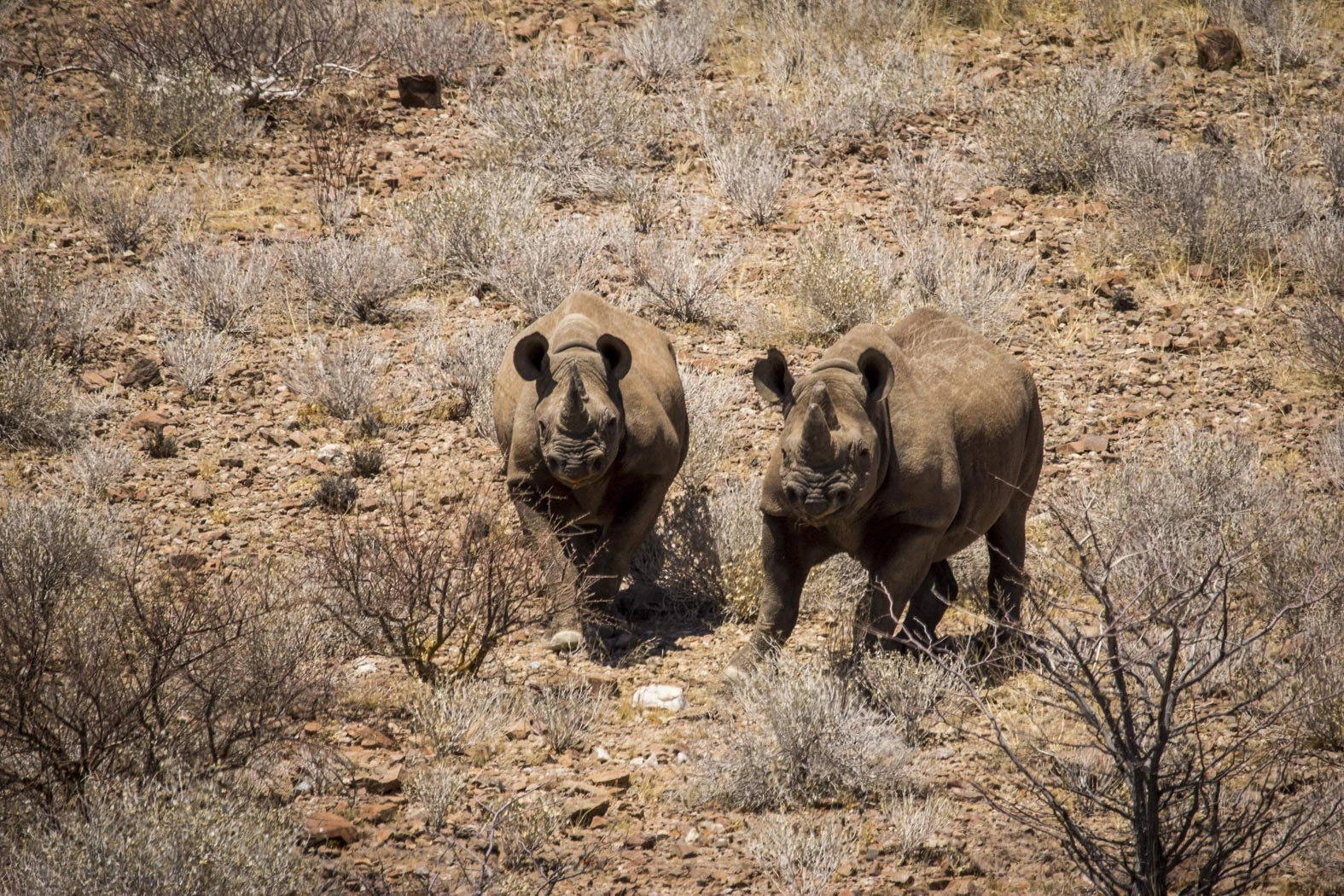
After nearly five hours searching the dry landscape of Damaraland, a black rhino finally appeared. The animal had been resting in the shade of a milk bush while the search party, including tracker Mensley Karutjaiva and members of the Save the Rhino Trust, scanned the rocky hills and open plains for signs of movement.
When the bull eventually stood, revealing two impressive horns, it was a remarkable sight. In regions where rhinos are frequently dehorned to discourage poachers, seeing an animal with both horns intact is particularly significant.
The encounter offered a glimpse of the progress taking place in northwest Namibia, a region that has become one of Africa’s most compelling conservation success stories.
For decades, Namibia has attracted travelers with its extraordinary desert scenery and self-drive adventures. But behind its dramatic landscapes, the country has also faced serious challenges involving human-wildlife conflict, habitat loss, and poaching. Black rhino populations were devastated during the 1970s and 1980s, with numbers falling by 96 percent by the mid-1990s. At their lowest point, only about 2,410 remained worldwide.
Today, the outlook is considerably brighter. Approximately 6,000 black rhinos now roam freely, with Namibia home to an estimated half of that population. In July 2026, the World Wildlife Fund reported that rhino poaching in Namibia had fallen by 53 percent since 2024, reaching its lowest level in more than a decade.
The progress is being supported by conservation initiatives, community partnerships, and growing investment in sustainable tourism.

A New Financial Commitment to Conservation
In May 2026, Namibia introduced Namibia for Life, a conservation financing initiative developed in partnership with the World Wildlife Fund. Valued at approximately $63 million, the program provides funding for the country’s 86 community-supported conservancies, which collectively cover more than 49 million acres.
The initiative recognizes the important role local communities play in protecting wildlife and managing natural resources.
For travel advisor Nicola Shepherd, who has visited Namibia regularly for nearly four decades, the growing commitment to conservation and community-based tourism represents a significant shift.
Shepherd, founder of conservation-focused travel company Explorations Company, has seen increasing investment in practical measures to protect both people and wildlife. Organizations such as Integrated Rural Development and Nature Conservation are working to reduce human-wildlife conflict while strengthening conservation efforts.
The country’s tourism industry is also expanding. Luxury properties from brands such as Zannier Hotels and Habitas have helped introduce Namibia to travelers seeking high-end experiences alongside extraordinary natural surroundings. Local reports have also pointed to strong hotel occupancy, reflecting growing international interest.
Desert Rhino Camp: Where Tourism Supports Wildlife Protection
More than twice the size of California, Namibia encompasses everything from dramatic coastlines and arid deserts to woodland and open savanna. Its northwest region brings together many of these landscapes, including the unusual grasslands surrounding the Palmwag Concession.
According to tracker Mensley Karutjaiva, tourism plays an important role in protecting the area’s rhinos. Carefully managed visitor activity helps support conservation work, although precise wildlife population figures remain confidential because poaching continues to pose a threat.
One of the region’s standout properties is Wilderness Desert Rhino Camp, which underwent a complete rebuild in 2024. Once a field station for wildlife research, the camp now features six independent tented suites designed with timber, leather, and stone.
The setting is equally impressive. The Etendeka Mountains rise in the distance, while red basalt boulders frame the open-air dining lounge. Dinner might include a slow-cooked lamb potjie stew, enjoyed beneath the desert sky.
Camp manager Fanus Katondoka explained that the importance of tourism became especially clear during the pandemic, when many businesses closed and local people lost their jobs. The return of visitors has brought renewed employment opportunities and investment in the region.
That economic activity also helps sustain the conservation teams working to protect rhinos and other wildlife.

Hoanib Elephant Camp: A Sanctuary for Desert-Adapted Wildlife
A short flight north of Desert Rhino Camp leads to the remote Kaokoveld region and the Hoanib Valley, where another conservation story is unfolding.
Flying over the Namib Desert in a small Cessna, the landscape reveals faded-yellow ridges, soft pink mountains, and unusual welwitschia plants. These remarkable plants can survive for hundreds of years, creating an almost otherworldly scene across one of the world’s oldest arid regions.
The next stop, Natural Selection’s Hoanib Elephant Camp, focuses on the valley’s remarkable desert-adapted elephants.
During the drive from the airstrip, guide Howard Groenewaldt stopped near the seasonal Hoanib River. Although dry for much of the year, the riverbed forms a sandy corridor lined with camelthorn trees and giant ana trees, some more than a century old.
It was here that a large desert-adapted elephant appeared, moving slowly across the sand. Its long, pale tusks and wide feet were distinctive adaptations to the challenging terrain.
The camp was designed around encounters like this. Located along the northern bank of the river, it offers 10 solar-powered suites, each with a private plunge pool, king-size bed, and writing desk. Guests can spend their time relaxing on private verandas, enjoying massages, or watching the surrounding landscape for passing elephants.
Evenings bring multi-course dinners in the shared lounge, followed by drinks around a bonfire beneath the stars.
Beyond its comfortable accommodation, the camp places strong emphasis on local employment and community involvement. Approximately 97 percent of its staff come from surrounding conservancies.
Camp manager Petty Daniels, who grew up in the nearby Torra Conservancy, understands the transformation taking place in the region. Having started her career in hospitality as a waitress, she now manages both Hoanib Elephant Camp and its giraffe-focused sister property, Hoanib Valley Camp.
Daniels has witnessed a growing appreciation for conservation among local residents. Where people once hunted wildlife to provide food for their families, more are now becoming involved in conservation tourism and recognizing the value of protecting animals.
Human-wildlife conflict has not disappeared. Elephants can wander into gardens, while cheetahs sometimes kill livestock. However, growing community participation and government support are helping shift attitudes toward protecting wildlife.
Ongava Game Reserve: Luxury, Wildlife, and a New Partnership
The final destination on the northwest Namibia journey was Ongava Game Reserve, a private conservation area covering more than 74,000 acres of savanna and mopane woodland beside Etosha National Park.
Getting there involved a drive east from the Hoanib Valley in a gas-electric hybrid vehicle arranged through ATI Holidays. Namibia remains a popular self-drive destination, supported by established visitor infrastructure. Travelers receive maps, a mobile phone with important contacts, and a first-aid kit before setting off.
For visitors covering several destinations, however, scheduled light-aircraft transfers can make the journey easier, particularly when time is limited.
At Ongava, Horizon by Ongava offers a more intimate safari experience. Following renovations and a name change, the property reopened in April 2026 with just three private hilltop villas.
The accommodations feature spacious interiors, four-poster beds, comfortable seating areas, and bathrooms with dual vanities. Outside, expansive decks overlook the surrounding landscape and include private plunge pools, outdoor showers, and dedicated dining spaces.
One particularly distinctive design detail is a bench carved in the shape of a serval, a wild cat native to sub-Saharan Africa.
Dining is another highlight. Chef Festus Ilyambo prepares dishes such as potato pavé, made with thinly sliced potatoes, butter, thyme, and cream before being sautéed with garlic. Filet mignon served with jus and cognac sauce is another standout.
Wildlife encounters are equally memorable. On a walking safari with experienced guide Pascalis Kazimbu, visitors can spot lilac-breasted rollers, white rhino mothers with their calves, and wildebeest moving across the reserve.
Later, a game drive offered an unforgettable encounter with a male lion. As evening settled around a watering hole, the animal emerged from the trees and approached the water, its deep roar reverberating through the surrounding landscape.
Together with neighboring Etosha National Park, Ongava provides a dramatic contrast to the deserts and dunes of the northwest.

The Ongava-Hai//om Joint Venture: Conservation With a Deeper Purpose
Beyond wildlife viewing and luxury accommodation, Ongava is preparing for a project that could become one of Namibia’s most important community conservation initiatives.
In 2024, Ongava and the Indigenous San Hai//om community reached a legally binding agreement to jointly manage a new conservation concession along the southeastern border of Etosha National Park.
The project, known as the Ongava-Hai//om Joint Venture, includes plans for a new lodge expected to open in 2028. The concession will protect thousands of acres, strengthen wildlife corridors, and safeguard the !Gobaob Spring, an important water source where black rhinos and other animals gather during the dry season.
For the Hai//om people, the agreement carries particular historical significance. The area forms part of their ancestral homeland, from which they were forcibly removed by the government during the 1950s.
The spring itself holds deep cultural importance. According to Ongava general manager of sales and marketing Rob Moffett, Hai//om oral history describes it as a water source that has never failed.
The joint venture is intended to give the community a meaningful role in managing and benefiting from the land. Under the 25-year agreement, the business will eventually transfer entirely to the Hai//om community in 2049.
The project represents more than a wildlife protection initiative. It offers an opportunity for an Indigenous community to regain a role in managing its ancestral territory while building long-term economic opportunities.
A More Hopeful Future for Namibia
The journey through northwest Namibia reveals how conservation and tourism can work together. From the trackers protecting endangered rhinos in Damaraland to the local teams managing desert safari camps and the Hai//om community preparing to reclaim a role in its ancestral homeland, the region is experiencing a meaningful transformation.
Luxury hospitality is helping attract visitors, while community employment and conservation funding are creating new reasons for local people to protect the landscapes and wildlife around them.
The challenges remain significant. Poaching, habitat pressures, and human-wildlife conflict continue to threaten vulnerable species. But the progress recorded in recent years suggests that a different future is possible.
For travelers, Namibia offers extraordinary encounters with wildlife and landscapes. For its communities, the growing conservation movement represents something even more important: the possibility of protecting their natural heritage while building lasting prosperity.
The black rhino, once pushed dangerously close to extinction, has become a powerful symbol of that promise. In northwest Namibia, the future of conservation is increasingly being shaped by the people who call this remarkable landscape home.