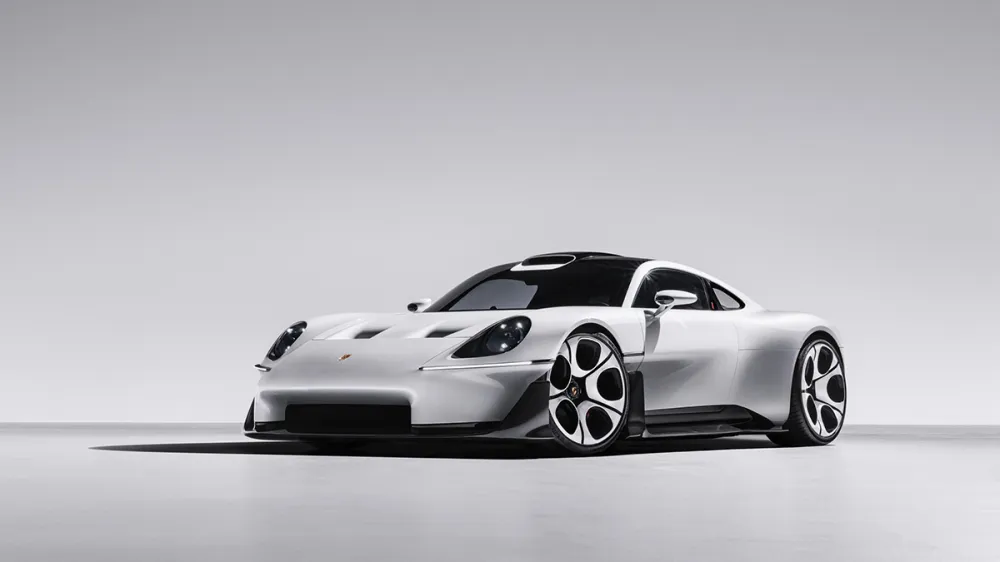
Porsche has unveiled the Mission S, a striking concept that previews the German automaker’s next supercar and signals the arrival of a new flagship performance model. Revealed in New York City on October 15, the concept offers a first look at a car intended to become a permanent addition to Porsche’s lineup, positioned above the iconic 911.
Described by the company as a “love letter to the sports car,” the Mission S combines familiar Porsche design cues with a contemporary aesthetic. While its technical specifications and production timeline remain undisclosed, the concept establishes the direction for the brand’s next chapter in high-performance engineering.
A New Chapter in Porsche’s Supercar Legacy
Porsche has a long history of producing exceptional sports cars, with the 911 remaining its most enduring model since its debut in 1964. However, the company has periodically introduced more ambitious machines designed to push beyond the 911’s established territory.
The 1985 Porsche 959 demonstrated the potential of advanced performance technology, while the road-going 911 GT1 Straßenversion brought the spirit of the marque’s endurance-racing program to public roads.
The Carrera GT, introduced in the early 2000s, later earned a reputation as one of the great analog supercars. In 2013, the 918 Spyder advanced Porsche’s performance ambitions with plug-in hybrid technology.
The Mission S now appears poised to continue that tradition. Rather than replacing the 911, it will occupy a higher position in the range, giving Porsche a dedicated flagship supercar for the years ahead.
A Design That Blends Porsche Heritage With Modernity
The Mission S is the first concept designed under Tobias Sühlmann, Porsche’s new head of design. Its exterior introduces a fresh visual identity while retaining details that connect it to the brand’s most celebrated models.
Round headlights evoke the familiar face of the 911, while the low, flat front recalls the 911 GT1. The roofline draws inspiration from the 959, creating a silhouette that balances classic Porsche proportions with a more contemporary interpretation of the supercar.
Clean surfaces and carefully integrated lighting define the concept’s appearance. The front and rear lights wrap around the body, reinforcing its streamlined look, while lightweight wheels introduce a new interpretation of the dial-style design associated with the Porsche 928.
Porsche CEO Michael Leiters emphasized the importance of preserving the marque’s visual identity, noting that a Porsche should be recognizable at first glance. According to Leiters, the Mission S previews ideas and design features that will influence the company’s vehicles in the coming years.
A Driver-Focused Interior
The concept’s cabin follows the same restrained design philosophy as its exterior. Drawing inspiration from early Porsche sports cars, including the 550 Spyder and 356, the interior aims to make the driver feel deeply connected to the vehicle.
Digital displays are present, but they are relatively small and complemented by physical buttons and switches. This combination suggests Porsche is seeking a balance between modern technology and the tactile controls that remain important to driving enthusiasts.
The minimalist layout also gives the cabin a timeless quality, avoiding an overwhelming reliance on screens and complex visual interfaces.
Mid-Engine Architecture Confirmed, Details Still Under Wraps

The new Porsche Mission S supercar.Porsche
Although Porsche has revealed the Mission S’s design, it has yet to disclose a complete set of mechanical specifications.
Leiters confirmed during the company’s recent Capital Markets Day event that the production model will use a mid-engine configuration, following the layout of the Carrera GT and 918 Spyder. The car will also be built on an entirely new platform.
Other details remain uncertain, including the engine configuration, power output, performance figures, and whether electrification will play a role in the final model.
A report published last month by German automotive newspaper Handelsblatt suggested that the production version could feature a flat-eight engine, potentially making it the first road-going Porsche to use that configuration. However, Porsche has not confirmed the report, and the possibility remains speculative.
A Permanent Addition to the Porsche Lineup
One important detail has been confirmed: the Mission S will not remain a one-off concept or become an ultra-limited production experiment. Porsche has described the future model as a permanent part of its lineup, with a position above the 911.
That decision suggests the company intends to establish a lasting place for a flagship supercar rather than simply create a celebratory model or technological showcase.
The production schedule, pricing, and market availability have not yet been announced. Until those details emerge, the Mission S remains a preview of Porsche’s ambitions rather than a fully defined production vehicle.
Nevertheless, the concept offers a compelling glimpse of what comes next for the marque. By combining heritage-inspired styling, a driver-focused cabin, and a confirmed mid-engine layout, Porsche appears determined to build a supercar that honors its past while establishing a distinct identity at the top of its range.