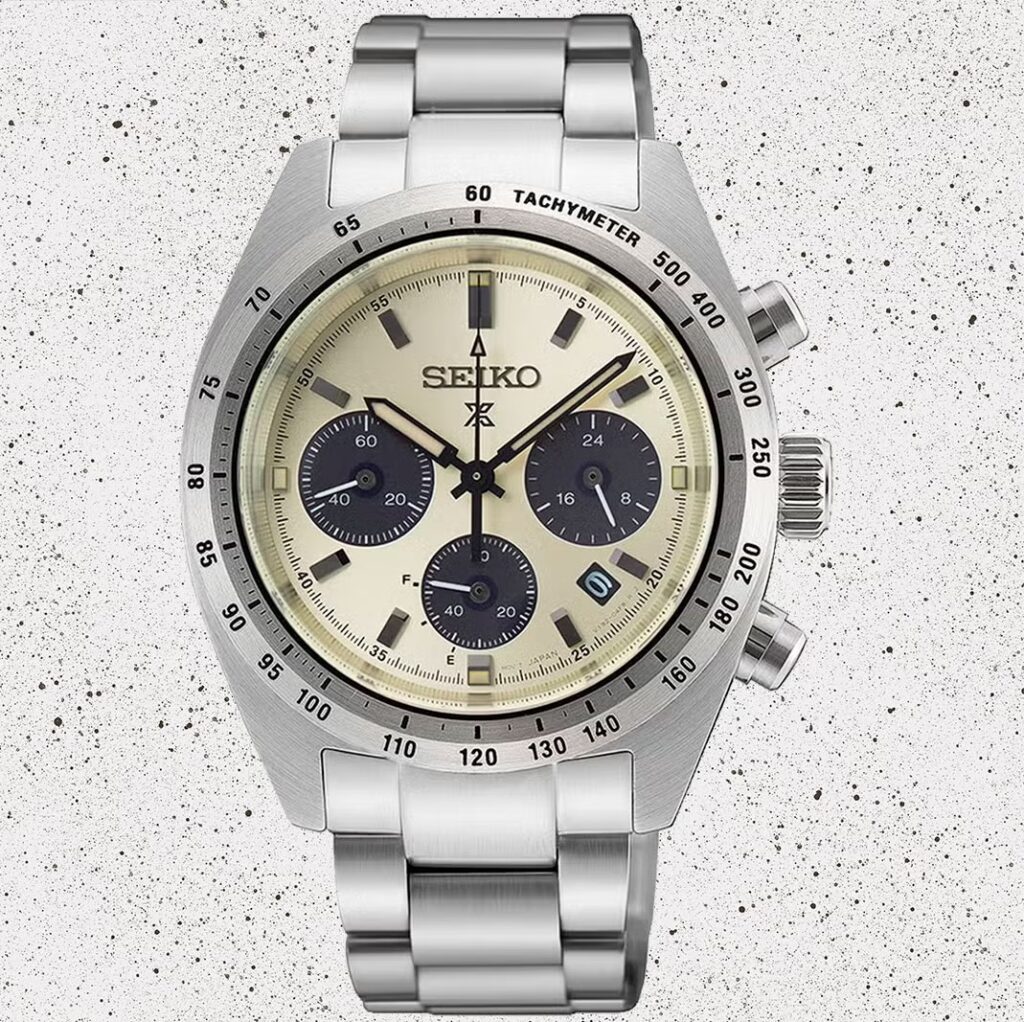
From the Omega Speedmaster to a Rolex-esque Seiko
A short history of one of watchmaking’s most enduring obsessions
By Robin Swithinbank
Published: 21 January 2026
The bond between cars and watches is as old as modern machinery itself. It’s mechanical, emotional, and perhaps a little Freudian — two obsessions built on precision, performance and the romance of speed. That connection continues to power today’s luxury partnerships, with watch brands and automotive giants circling each other like pit crews and pole-position drivers.
Tag Heuer’s return as Formula One’s Official Timekeeper in 2025, under LVMH’s sprawling luxury umbrella, marked a major shift. It replaced Rolex’s long-standing role and opened the grid to a new wave of brand alliances. IWC Schaffhausen, Richard Mille, Tudor and H. Moser & Cie. now back individual teams and drivers, reinforcing how deeply watchmaking remains embedded in motorsport culture.
Yet for all that, the idea of a true “driver’s watch” remains slightly elusive — certainly more so than tool watches made for divers or pilots. That’s largely because the defining feature of most driving watches, the chronograph, appears across countless categories. A stopwatch complication alone doesn’t automatically make a watch suitable for the racetrack.
So how do you spot one?
Often, it’s written right there on the dial. Rolex’s Daytona takes its name from the legendary speedway. TAG Heuer’s Carrera references the brutally dangerous Carrera Panamericana road race of 1950s Mexico. Then there are the endless co-branded editions born from partnerships between watchmakers and car manufacturers.
Most classic driver’s watches feature chronographs, frequently paired with a tachymeter — usually printed around the dial or engraved on the bezel — designed to calculate speed over a fixed distance. In practice, few owners still use it that way, but aesthetically, it’s essential. Add a perforated leather strap, originally intended to keep wrists cool during long stints behind the wheel, and the look is complete.
The golden era of driver’s watch design arrived in the 1960s. Visionaries like Jack Heuer realised that younger men wanted something different from the conservative, military-inspired watches their fathers wore. The result was a new generation of sporty, stylish, attainable chronographs that captured the spirit of racing — and rebellion — perfectly.
Buyer’s Guide: How to Choose a Proper Driving Watch
Start with the chronograph
If authenticity matters, a chronograph is non-negotiable. Lap times can’t be measured without one, and every classic motorsport watch worth its salt includes this complication. While some modern “driver-inspired” pieces skip it, the purists never do.
Know the history
Provenance matters. The Omega Speedmaster Professional may be famous for going to the moon, but it was originally designed as a racing chronograph. Seiko’s 1969 Bullhead, meanwhile, was conceived as a wrist-mounted stopwatch, with its pushers mounted on top for easier access while driving.
Don’t fear the tachymeter
It may look confusing at first, but the tachymeter is simply a speed calculator, originally used to measure a “flying mile.” It’s rarely practical today, but visually and historically, it’s part of the DNA.
Hollywood approval doesn’t hurt
Many of the most iconic driver’s watches are inseparable from the stars who wore them. Paul Newman’s “exotic dial” Rolex Daytonas — now one of the most collectible watches on the planet — helped cement the genre’s cool factor forever.
The Watches to Buy

Seiko Prospex Speedtimer ‘Motoring’

Reservoir 390 Fastback Automatic

Porsche Chronograph 1

TAG Heuer Monaco Chronograph

Rolex Cosmograph Daytona

OMEGA Speedmaster