For almost a century, the world of watchmaking has been inextricably linked with land, sea, and sky. Horology has long embraced adventure, from tough tool watches designed for divers and aviators to beautiful chronographs worn on racetracks. However, a new frontier is catching the imaginations of both collectors and brands: outer space.
The space race—both governmental and private—is motivating luxury watchmakers to push the boundaries of materials, engineering, and storytelling, much as the automobile and aviation industries used to fuel horological innovation. The fascination with space has become one of the most significant trends in modern watch design, with meteorite dials, NASA-approved chronographs, and timepieces that literally travel beyond the Earth’s atmosphere.
This article explores the history, innovations, and future of space-inspired watches, diving into the brands leading the charge and why collectors are captivated by these cosmic connections.
(Image credit: Courtesy of brand)
Why Space Matters in Watchmaking
Watches have long been linked to high-performance environments. The logic is simple: if a timepiece can withstand the crushing depths of the ocean or the turbulence of the cockpit, it earns credibility as both a tool and a luxury object. Space, however, represents the ultimate challenge.
Temperatures range from blistering heat to extreme cold. Magnetic fields, zero gravity, and radiation threaten delicate movements. For a mechanical watch to survive in orbit—or on the surface of the Moon—it must be engineered at the very edge of horological science.
And beyond the technical demands lies the symbolism. Space is humanity’s final frontier, the embodiment of exploration, ambition, and curiosity. Owning a space-connected watch isn’t just about precision; it’s about wearing a piece of that dream on the wrist.
(Image credit: Courtesy of brand)
The Omega Speedmaster, the original “Moonwatch”
No discussion on space watches can begin without mentioning the legendary Omega Speedmaster Professional. When Buzz Aldrin walked on the Moon as part of Apollo 11, the Speedmaster became the first watch to be worn on the lunar surface. NASA certified the Speedmaster in 1965 following a series of severe testing, and it survived conditions that devastated competitors such as Rolex and Longines.
The Speedmaster‘s contribution in the Apollo 13 mission solidified its significance. When the onboard computers failed, astronaut Jim Lovell utilized his Speedmaster to time a vital engine burn, resulting in a safe re-entry. This single act transformed the Speedmaster from a chronograph into a life-saving device and cultural icon.
Decades later, Omega continues to honor this heritage. The Speedmaster “Moonwatch” remains one of the brand’s bestsellers, and new versions such as the Speedmaster X-33 Marstimer carry NASA certification for modern missions. Omega has also partnered with Privateer, a program backed by Apple co-founder Steve Wozniak, focusing on space debris management, further tying the brand to the future of space exploration.
Meteorite Dials: Wearing a Piece of the Cosmos.
If the Speedmaster symbolizes space via history and practicality, meteorite dials bring a bit of the universe to the wrist.
Brands like as Rolex, Omega, Girard-Perregaux, Czapek, Louis Vuitton, and Formex have adopted this trend. The attraction is clear: meteorite fragments are billions of years old, produced in cosmic collisions long before the Earth was formed.
Formex Essence Meteorite Chronometer.
Formex commemorated its 25th anniversary with the Essence Chronometer Meteorite Edition, which features a dial carved from the Muonionalusta meteorite, which is estimated to be 4.5 billion years old. Each dial features a unique Widmanstätten design, which is a crystalline structure generated by slow cooling in space.
But Formex goes further. To distinguish its meteorite watches, the brand developed a proprietary electroplating process, enhancing the natural iron content with gold, silver, or blue finishes. Its latest Space Ghost edition showcases this innovation, making the extraterrestrial material shimmer in unexpected ways.
As Markus Walchli, Formex’s brand director, puts it: “This is a material that allows wearing something actually extraterrestrial on the wrist.”
Diatom: Tangible Connections to Space
While many brands lean on symbolic links to space, Diatom is taking a bolder approach—offering literal connections to space travel.
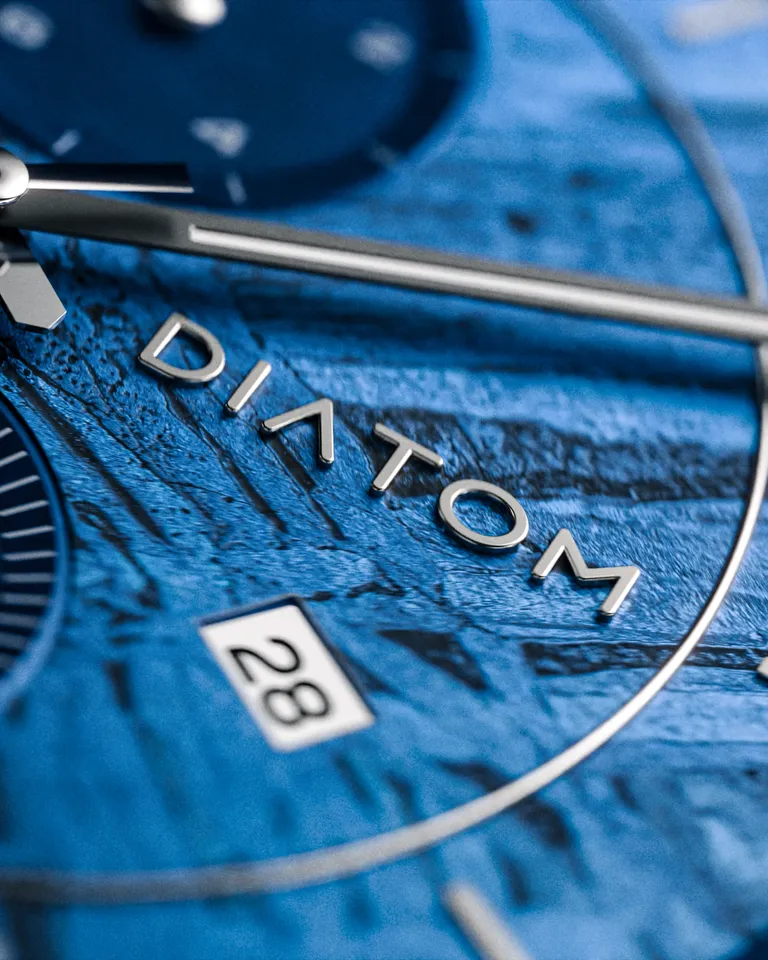
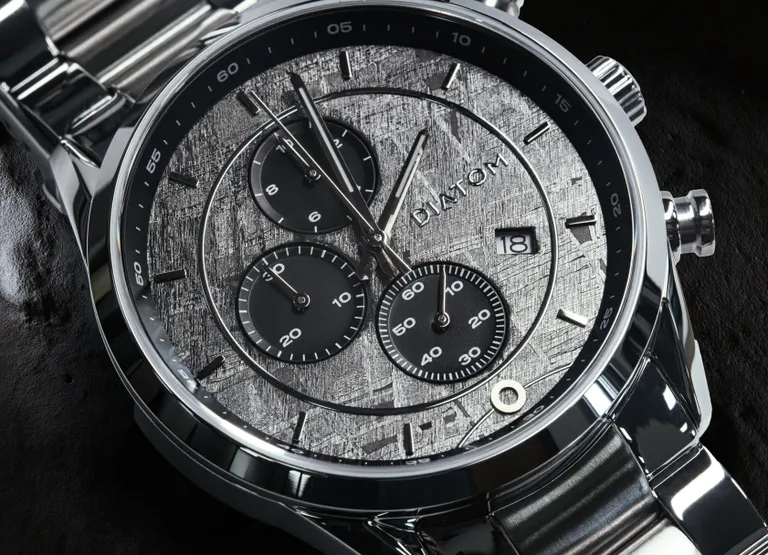
A spin-off of the engineering company Sent Into Space, Diatom ensures that every watch it produces actually travels into space before delivery. Customers can access footage of their individual watch making the journey beyond the atmosphere.
But the brand’s Inner Worlds collection, set to launch in 2026, goes further. These watches will incorporate certified space-related materials, including:
(Image credit: Courtesy of brand)
- Moon rock fragments
- Mars rock specimens
- Pieces of the Atlas rocket used in NASA’s Mercury missions
- A fragment from the Apollo 13 capsule
Because these materials are rare and fragile, they are used in small, visible details rather than entire dials. Still, they create a compelling narrative: a timepiece that doesn’t just reference space—it contains space.
Co-founder Chris Rose explains: “Customers are looking for a physical, tangible link to space. These materials make for great storytelling without just being a story—you can actually see them.”
Fortis: Tool Watches for Mars
If Diatom is about storytelling and Omega about heritage, Fortis is about practical engineering for the future.
Founded in 1912, Fortis has reinvented itself as a leader in space-capable tool watches. The brand works closely with organizations like the Austrian Space Forum and the Swedish Space Corporation, testing its watches in simulated Mars environments and near-space missions.
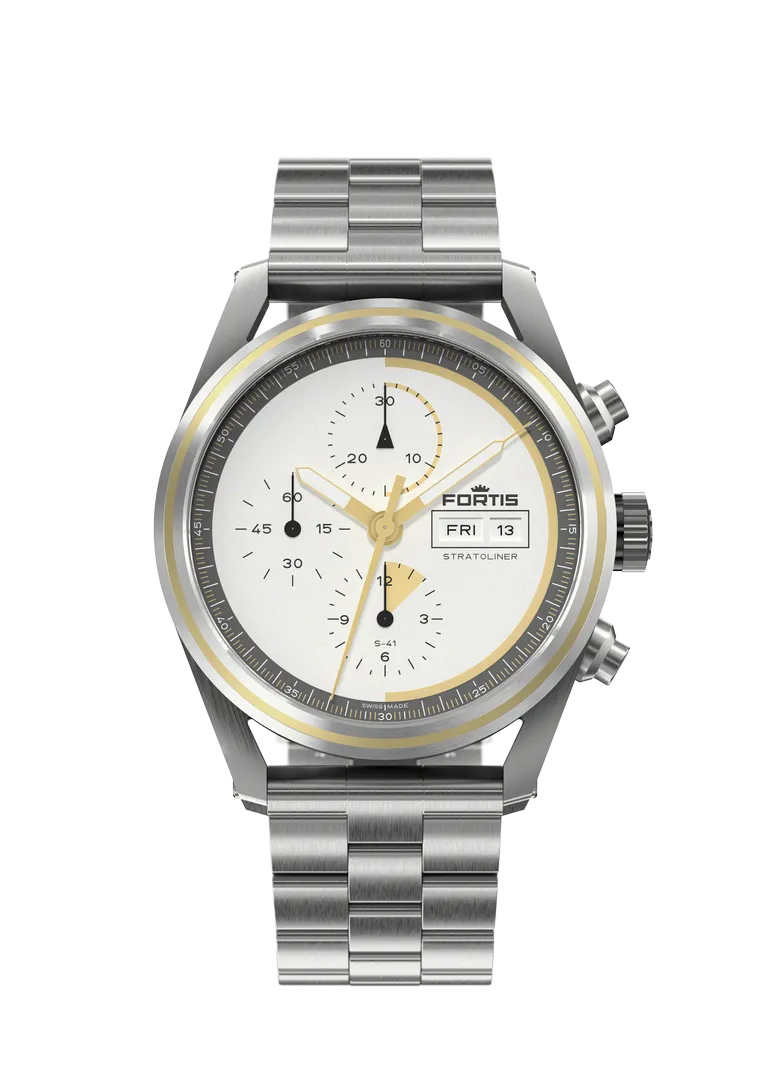
The Fortis Stratoliner
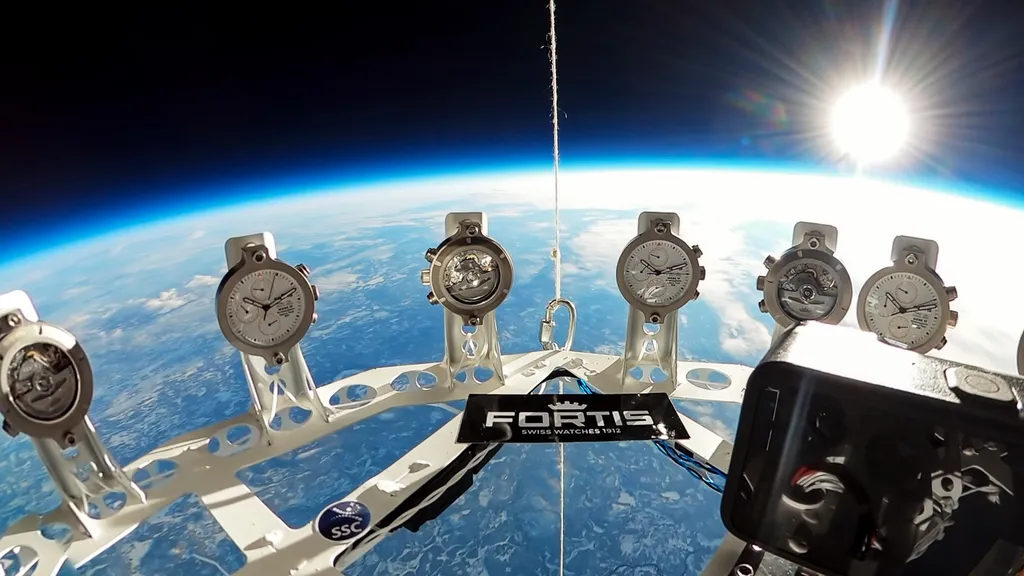
In 2021, Fortis launched 13 Stratoliner movements to an altitude of 30 kilometers using high-altitude balloons. All returned fully functional after parachuting into a remote forest in Finland.
The Fortis Novonaut
In 2024, Fortis supplied its Novonaut watches to the Amadee-24 mission, a terrestrial Mars simulation project. These watches endured harsh desert conditions meant to mimic Martian life.
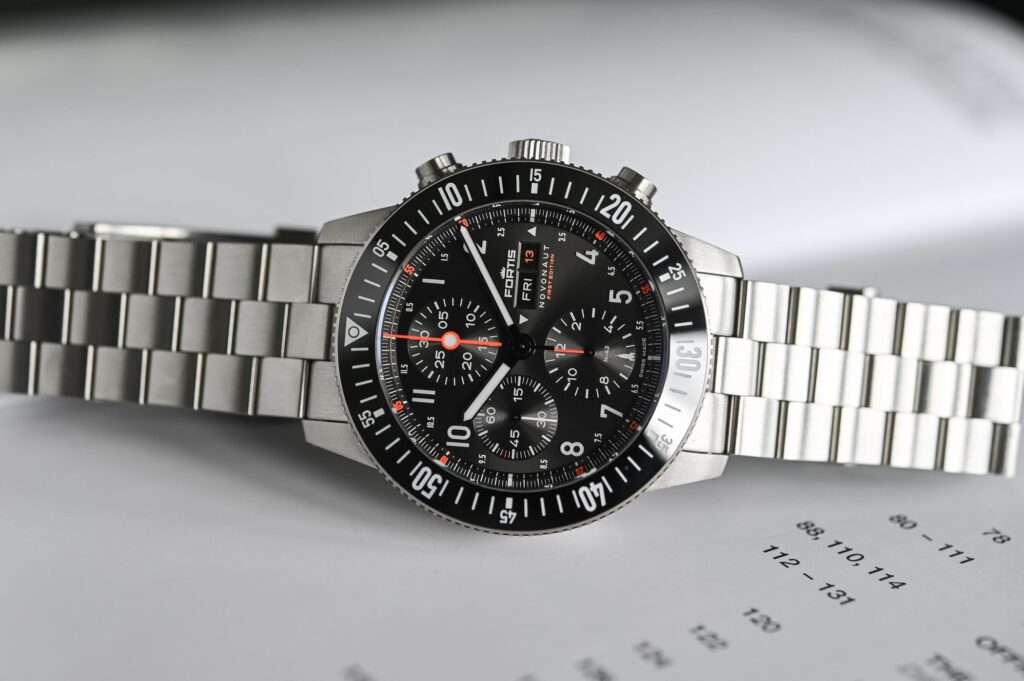
Andreas Bentele, Fortis’ head of marketing, emphasizes the practical point: “If a watch can survive the extremes of temperature, pressure, and vibration that space entails, it can survive anything on Earth.”
Fortis’ ultimate goal? To create a watch worthy of selection for the first manned Mars mission.
Experimental and Artistic Approaches
Not every brand approaches space with engineering rigor. Some embrace imagination and artistry, crafting watches that celebrate the romance of the cosmos.
Louis Vuitton Tambour Taiko Galactique
This extravagant minute repeater, priced in the millions, features animated dial elements: a flag-planting astronaut, moving satellites, and orbiting shooting stars. It’s a whimsical celebration of space exploration, blending haute horology with cosmic storytelling.
Rado Diastar Original x Tej Chauhan
Inspired by sci-fi aesthetics and the film Ad Astra, Rado collaborated with designer Tej Chauhan on a bold oval-cased watch resembling an astronaut’s helmet. It reflects how science fiction continues to inspire watch design, bridging horology with cultural visions of the future.
The Role of Private Spaceflight in the Watch Industry
The emerging space age, spearheaded by enterprises such as SpaceX, Blue Origin, and Virgin Galactic, has provided watch brands with new opportunity to engage with exploration.
In 2024, IWC provided Pilot’s Chronographs for SpaceX’s Polaris Dawn mission. These timepieces, made of strong white porcelain, even survived a spacewalk before being auctioned off for charity.
Micromilspec, a Norwegian firm known for robust tool watches, will become the official supplier to the United States Space Force (USSF) in 2023, producing a dedicated “unit watch” for its soldiers.
Former NASA engineer Karel Bachand founded Barrelhand, which is developing the Monolith EVA, a prototype developed exclusively for spaceflight with redesigned components, shock-resistant movement, and flexible straps ideal for zero gravity.
These collaborations underline how space has become not just a metaphor but a proving ground for contemporary watchmaking.
Why Collectors Love Space Watches
Space-inspired watches resonate deeply with collectors for several reasons:
- Heritage and Legacy – Owning a Moonwatch or meteorite-dial piece connects the wearer to history and humanity’s greatest explorations.
- Materials from Beyond Earth – Meteorites, moon dust, and Mars rock make these watches unique pieces of the cosmos.
- Engineering Excellence – Surviving spaceflight requires unparalleled precision and resilience, appealing to enthusiasts who value performance.
- Storytelling and Symbolism – Space watches represent ambition, exploration, and pushing beyond limits—values that resonate universally.
- Exclusivity – Many space watches are limited editions, increasing desirability among collectors.
The Future of Space-Inspired Horology
The “space race” in watches shows no signs of slowing. As private space missions expand and new materials become available, anticipate more brands to investigate this cosmic connection.
Future advances may include timekeeping on Mars, where a day lasts 24 hours and 39 minutes, posing unique challenges.
Radiation-resistant movements intended for deep-space trips.
Space mining, which uses extraterrestrial materials, will enable sustainable watchmaking.
As Andreas Bentele of Fortis notes, “Getting that message across will take time, but space pushes us to build watches that can survive anything—on Earth or beyond.”
From the Omega Speedmaster’s lunar triumph to the meteorite dials of Formex, the space material experiments of Diatom, and Mars-ready tool watches from Fortis, the watch industry is clearly embracing its next great frontier.
Space watches embody a perfect fusion of science, symbolism, and storytelling. They appeal not just as luxury accessories, but as tributes to humanity’s drive to explore the unknown. Whether crafted from billion-year-old meteorites, tested in near-space, or carrying fragments of Apollo history, these timepieces represent something larger than horology—they represent the spirit of exploration itself.
As the second space race unfolds—this time led by private companies and visionary watchmakers—the industry is boldly proving that the future of horology is not just tied to Earth, but to the stars.