Will TAG Heuer’s Carbon Hairspring Transform Watchmaking?
At Geneva Watch Days 2025, TAG Heuer announced a discovery that has the potential to transform the fundamental underpinnings of modern horology: the carbon hairspring, also known as the TH-Carbonspring. While it may appear to be a minor material alteration, it could represent a seismic shift in the realm of precision watchmaking.
This improvement does more than polish an old idea; it challenges centuries of convention, with the potential to create a new benchmark for accuracy, durability, and long-term performance in luxury mechanical timepieces.
What Is a Hairspring and Why Does It Matter?
The hairspring (also called a balance spring) is one of the most critical components in a mechanical watch. Attached to the balance wheel, it controls oscillations, ensuring the watch ticks at a precise rate. Without it, a watch would lose its ability to measure time consistently.
Traditionally, hairsprings were made of metal alloys such as Nivarox, developed in the early 20th century. Later, in the 2000s, silicon hairsprings emerged, bringing enhanced resistance to magnetism and changes in temperature—two of the biggest challenges in watch accuracy.
However, while silicon is widely praised for its stability, it is also brittle. Even though silicon hairsprings rarely crack, “almost never” is not good enough for an industry where collectors expect mechanical watches to last generations.
This is where TAG Heuer steps in. Instead of making silicon stronger, the brand has taken a radical leap forward by introducing a hairspring made from carbon nanotube-templated structures.
Why Carbon Is a Game-Changer
Carbon as a material offers distinct advantages over both metal and silicon:
- Shock Resistance – Carbon hairsprings are less prone to cracking under sudden impact. This makes them more robust for everyday use and sports applications.
- Magnetic Resistance – Like silicon, carbon resists magnetism, protecting precision in an increasingly electronic-driven world full of magnetic fields.
- Temperature Stability – Carbon maintains consistent performance across a wide range of temperatures, reducing timekeeping deviations.
- Design Flexibility – Carbon’s molecular structure allows more freedom in shaping, enabling innovations in geometry and functionality that metals or silicon cannot easily match.
In short, the TH-Carbonspring offers durability, accuracy, and versatility—three qualities that mechanical watches must balance to remain relevant in the age of smartwatches.
A Decade In The Making
This breakthrough was not achieved without some difficulty. TAG Heuer spent more than ten years creating the carbon hairspring, investing millions in research and overcoming numerous obstacles. There were times when the project seemed doomed, yet perseverance paid off.
Working with research into carbon-infiltrated, nanotube-templated structures, TAG Heuer engineers developed the procedure to mass-produce a hairspring that was not only functional but also reliable enough for full-scale production.
By 2025, the firm has finally released the technology in two limited-edition watches:
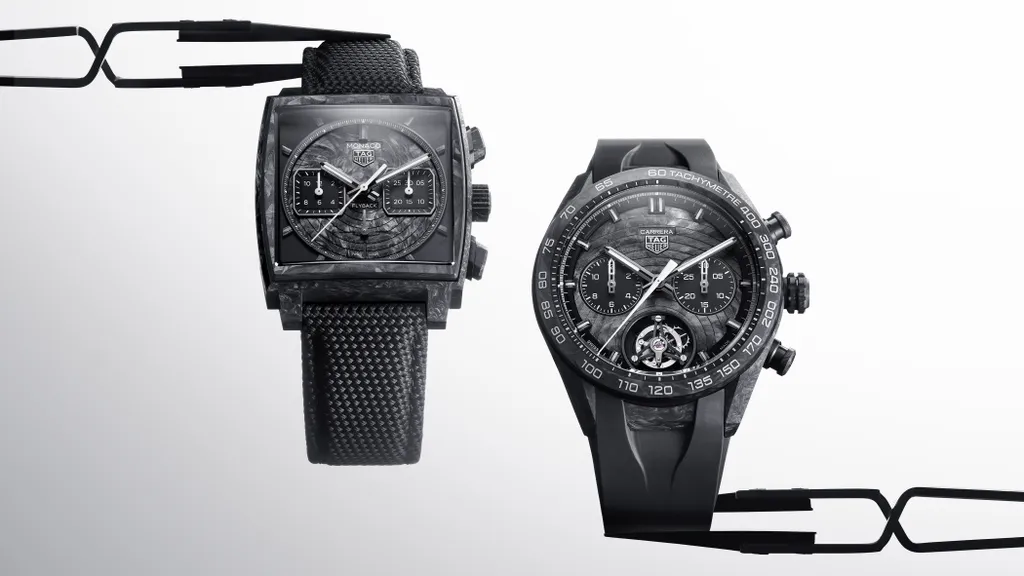
TAG Heuer Monaco Flyback Chronograph, TH-Carbonspring
TAG Heuer Carrera Chronograph Tourbillon Extreme Sport (TH-Carbonspring)
Both timepieces serve as testing grounds for a technology that could eventually extend throughout the TAG Heuer lineup—and possibly the entire watch industry.
The First Carbon Hairspring Watches
1. TAG Heuer Monaco Flyback Chronograph TH-Carbonspring
- Design: Black forged-carbon indices, carbon dial, and black-gold-plated hands with white Super-LumiNova for legibility.
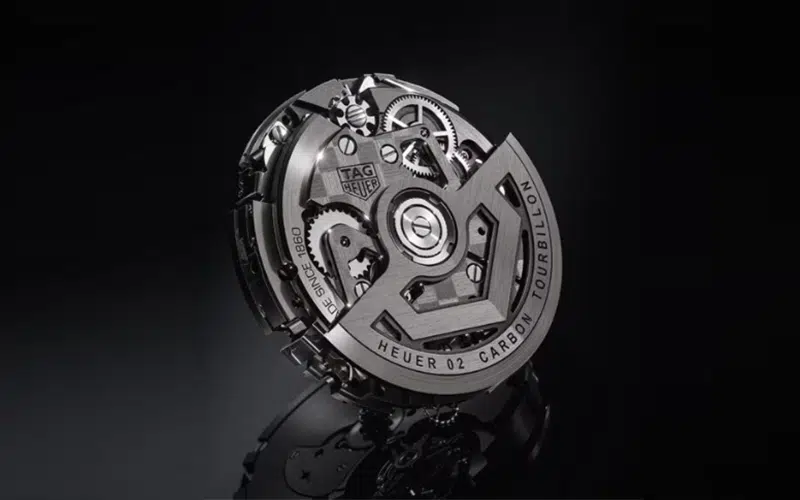
- Movement: Features the TH-Carbonspring, ensuring improved accuracy and durability.
- Edition: Limited to 50 pieces worldwide.
This model ties TAG Heuer’s racing heritage to cutting-edge technology, embodying both tradition and forward-thinking design.
2. TAG Heuer Carrera Chronograph Tourbillon Extreme Sport TH-Carbonspring
- Design: A high-tech interpretation of the iconic Carrera with lume-filled hour markers, carbon dial detailing, and robust sport styling.
- Movement: Houses a tourbillon regulated by the TH-Carbonspring, highlighting TAG Heuer’s mastery of advanced complications.
- Edition: Also limited to 50 pieces, ensuring exclusivity.
Together, these models represent the first step in introducing the TH-Carbonspring to the world, combining heritage aesthetics with futuristic engineering.
How Does the Carbon Hairspring Improve Performance?
- Chronometric Precision
By reducing inertia in the balance wheel, the carbon hairspring ensures more consistent oscillations, improving timekeeping accuracy over long periods. - Durability for Sports and Everyday Wear
Unlike silicon, which can break under high shock, carbon provides strength and elasticity, making it ideal for sports watches and daily use. - Resistance to Environmental Stress
The carbon hairspring resists both temperature variations and magnetic interference, two factors that frequently disrupt mechanical movements. - Longevity and Collector Confidence
With improved toughness and stability, collectors can expect the carbon hairspring to last for decades, securing its place as a future-proof innovation.

Historical Significance: From Huygens to TAG Heuer
The hairspring’s history dates back to Christiaan Huygens in the 17th century, who introduced the balance spring concept to regulate mechanical watches. For centuries, alloys like steel and Nivarox dominated. In the 21st century, silicon emerged as the revolutionary alternative.
Now, in the 2020s, TAG Heuer’s carbon hairspring may mark the next evolutionary leap, bridging traditional horology with nanotechnology.
This places TAG Heuer in the company of industry leaders such as Omega, Rolex, and Patek Philippe—brands that also innovate with hairsprings but rely heavily on silicon. By going in an entirely different direction, TAG Heuer sets itself apart as a true disruptor.
Patents and Industry Implications
TAG Heuer has filed four patents for its TH-Carbonspring technology, protecting its research and ensuring exclusivity. While it will initially remain limited to high-end models, the potential for industry-wide adoption is real.
Much like silicon transformed watchmaking in the early 2000s, carbon could redefine what collectors expect in terms of accuracy and resilience. Other brands may follow, but TAG Heuer has established itself as the pioneer.
Collector Value and Exclusivity
The first two models with TH-Carbonspring technology are limited to just 50 pieces each. For collectors, this scarcity adds significant value. Early adopters are not just purchasing watches—they are securing pieces of horological history.
Over time, the Monaco Flyback Chronograph and Carrera Tourbillon Extreme Sport may become reference points, much like early silicon-equipped models are now considered milestones.
The Role of Watch Winders in Preserving TH-Carbonspring Watches
Enthusiasts often ask: if a watch is not worn daily, how can its movement remain precise? The answer lies in watch winders, which keep automatic movements running smoothly.
For TAG Heuer’s new models:
- Quiet and Controlled Rotation prevents overwinding.
- Multiple Watch Storage benefits collectors with several limited editions.
- Stable Environments protect against unnecessary vibrations or shocks.
Pairing the TH-Carbonspring watches with a high-quality winder ensures that precision is preserved even when the watch rests off the wrist.
Future of Carbon Technology in Watchmaking
TAG Heuer has already intimated that the carbon hairspring is only the beginning. Complementary technologies are being developed, which could lead to carbon-based escapements, wheels, or perhaps complete oscillator assemblies.
This could result in more cheap versions adopting the technology.
Sports watches are becoming more durable than ever before.
Tourbillons and haute horlogerie items benefit from increased precision.
The impact on the industry could be significant, impacting not only TAG Heuer’s collections but also inspiring other Swiss brands to experiment with carbon nanostructures.
Why the Carbon Hairspring Matters
True innovations are rare in the premium watchmaking industry. Many “new” products focus on aesthetics, limited editions, or pre-existing difficulties. The introduction of the TH-Carbonspring is unique.
It represents:
A fundamentally different approach to time regulating in mechanical timepieces.
A link between tradition and nanotechnology.
A landmark that collectors, horologists, and brands will examine for decades.
TAG Heuer is giving more than just a novelty; it may have introduced the mechanical watch’s future heartbeat.
The debut of TAG Heuer’s carbon hairspring at Geneva Watch Days 2025 may be the decade’s most significant horological development. By overcoming silicon’s shortcomings while providing improved longevity, magnetism resistance, and performance, the TH-Carbonspring establishes TAG Heuer as a true pioneer in modern watchmaking.
It remains to be seen whether this technology will spread throughout the industry, but one thing is certain: the Monaco Flyback Chronograph TH-Carbonspring and Carrera Tourbillon Extreme Sport TH-Carbonspring are more than just limited editions; they represent the next chapter in watchmaking.
For collectors and aficionados, this is like standing on the verge of a new age. TAG Heuer’s carbon hairspring, similar to the creation of the balancing spring in the 17th century and the adoption of silicon in the 21st, may be recognized as the innovation that redefined precision for the 22nd century.