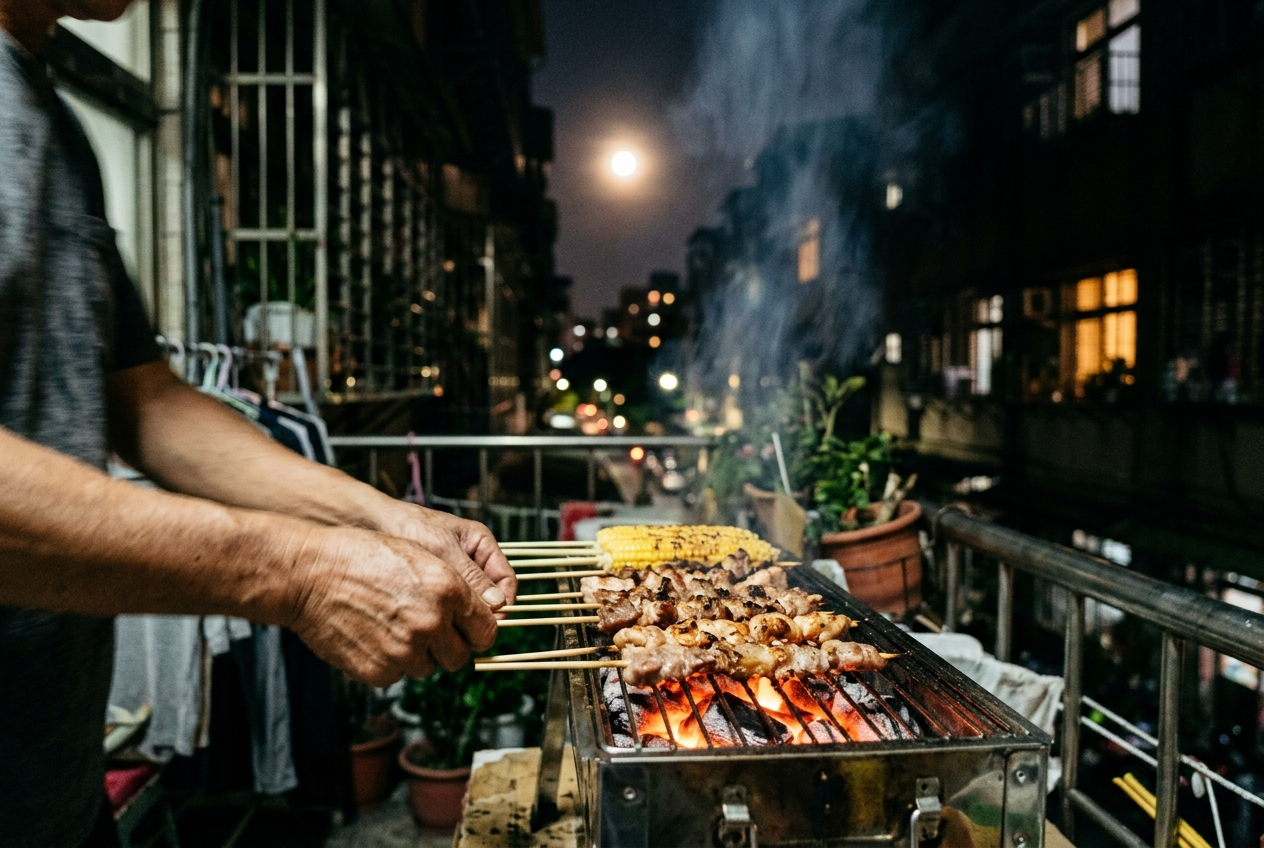
You would expect a festival named for the moon to begin with the moon. In Taiwan it begins with smoke. For one night in autumn the whole island seems to light a small charcoal grill at once — on balconies, in driveways, along the concrete banks of rivers, in the car parks of apartment blocks — and the air goes thick and sweet with the smell of basting sauce. The moon is up there, round and generous, and almost nobody is looking at it. They are turning skewers.
This is the Mid-Autumn Festival, 中秋節, the second most important holiday in the Taiwanese year after Lunar New Year. It falls on the fifteenth day of the eighth lunar month, when the moon is at its fullest and roundest, which in 2026 means the twenty-fifth of September. It is a public holiday, often stretched into a long weekend, and it carries centuries of poetry about reunion, longing, and the moon as a thread connecting people who are far apart. It is also, in modern Taiwan, a barbecue. Both of these things are completely true at the same time, and the gap between them is one of the most Taiwanese things there is.
Why an island barbecues on a moon festival
Here is the honest origin, and it is younger than you think. Grilling was never an ancient Mid-Autumn rite. The tradition is essentially an accident of advertising. In the 1980s a Taiwanese barbecue-sauce brand ran a campaign built on the jingle 一家烤肉,萬家香 — ‘one family grills, and a thousand homes smell it.’ A rival sauce brand pushed the same idea. The ads were everywhere, the sauce was cheap, the weather in late September is finally cool enough to sit outside, and the holiday already meant gathering. Within a decade or so, a marketing line had quietly become a national custom. Now the supermarkets stack grills and tongs by the door in September, and asking why is a little like asking why turkey — everyone just does it.
What makes it work is how low the barrier is. You do not need a garden or a fancy setup. A disposable foil tray, a bag of charcoal, a paper fan to coax the coals, and a folding table are enough. Families claim a patch of riverside park, neighbours drag chairs into the shared driveway, students crowd onto a rooftop. The grill is small, the evening is long, and the cooking is deliberately slow — that is the point. Nobody is in a hurry to finish. The food is really an excuse to sit together for four hours under a bright moon.
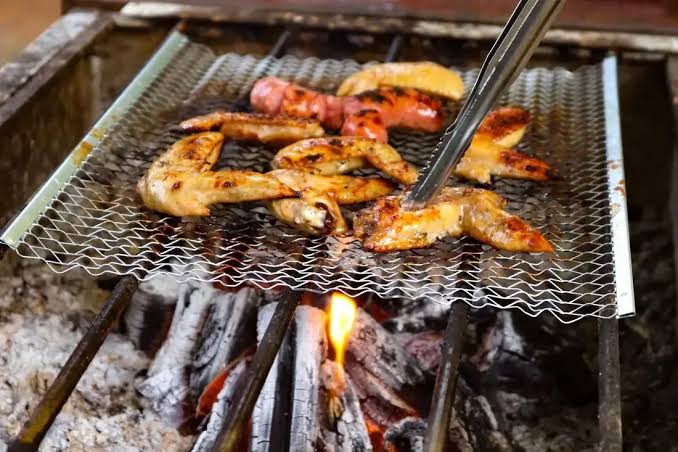
The menu is its own small canon. Thin-sliced pork and beef basted in that sweet, soy-heavy sauce; whole corn on the cob turned slowly until it chars; clams and prawns and fat Taiwanese sausages; king oyster mushrooms; and, unmissably, slices of white bread laid on the grill, painted with condensed milk, and eaten hot. There is usually a cooler of beer and sugarcane-sweet drinks, a stack of mooncakes someone brought, and a pomelo being clumsily peeled. It is not refined food. It is the food of a night that is really about the company.
The mooncake, and how to eat one without regret
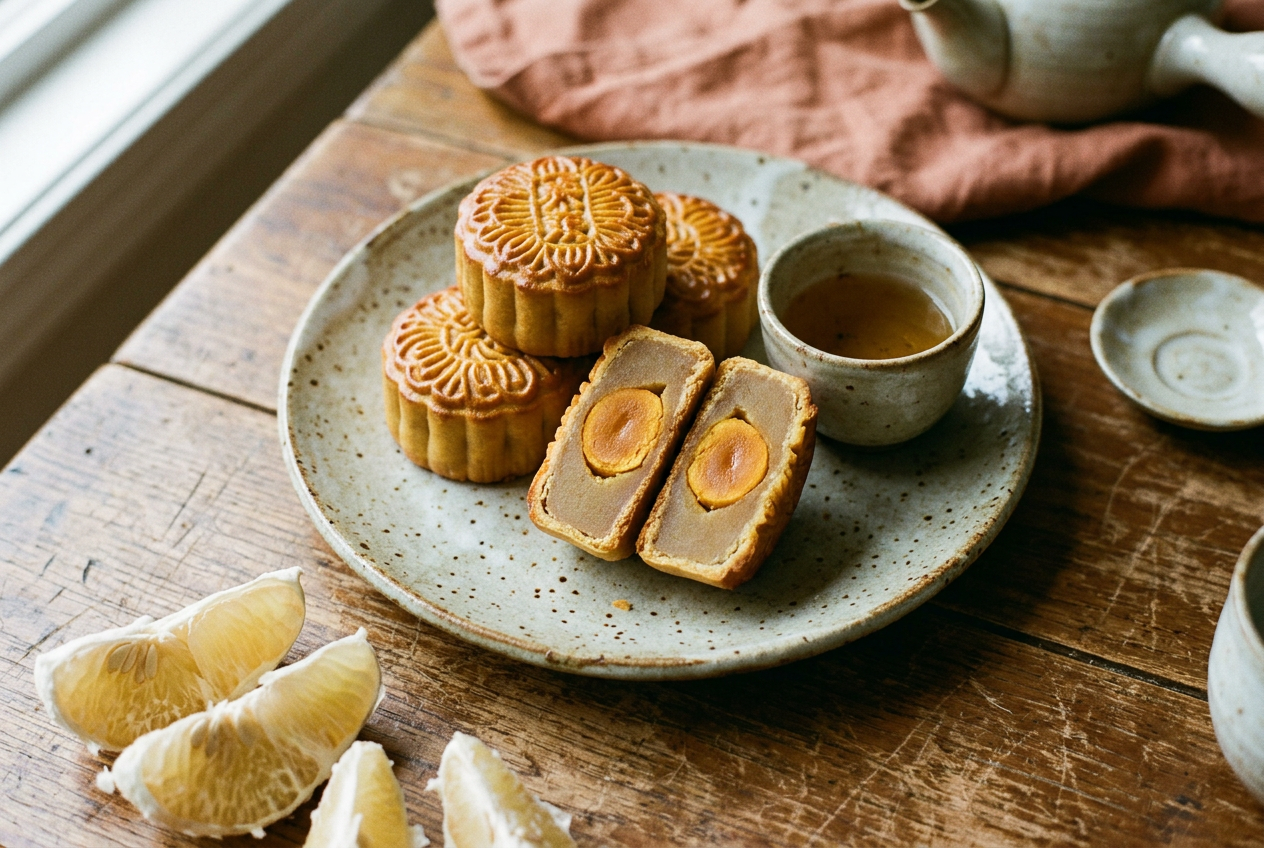
The mooncake, 月餅, is the festival’s edible symbol, and it deserves respect and caution in equal measure. The classic is a dense, palm-sized round of lotus-seed paste wrapped in a thin baked skin, often hiding one or two salted duck-egg yolks at the centre to stand in for the full moon. It is rich in a way that surprises people the first time — a whole one is a lot of sugar and lard, closer to a slab of fudge than a cookie. The unspoken rule is that you slice it into quarters and share it with tea. Eating a whole mooncake alone is possible, but you will feel it.
Taiwan has its own regional favourites beyond the Cantonese lotus-paste style. The 蛋黃酥 is a smaller, flaky pastry with a whole salted yolk buried in sweet red-bean or mung-bean paste, and for many Taiwanese families it is the real star. There is snow-skin (冰皮) mooncake, unbaked and chewy and kept cold; taro and mochi versions; and, increasingly, bakery collaborations with fillings that would horrify a purist. In the weeks before the festival, good bakeries take orders, department stores build towers of gift boxes, and choosing which box to give matters more than you would guess.
The pomelo, the moon, and a rabbit
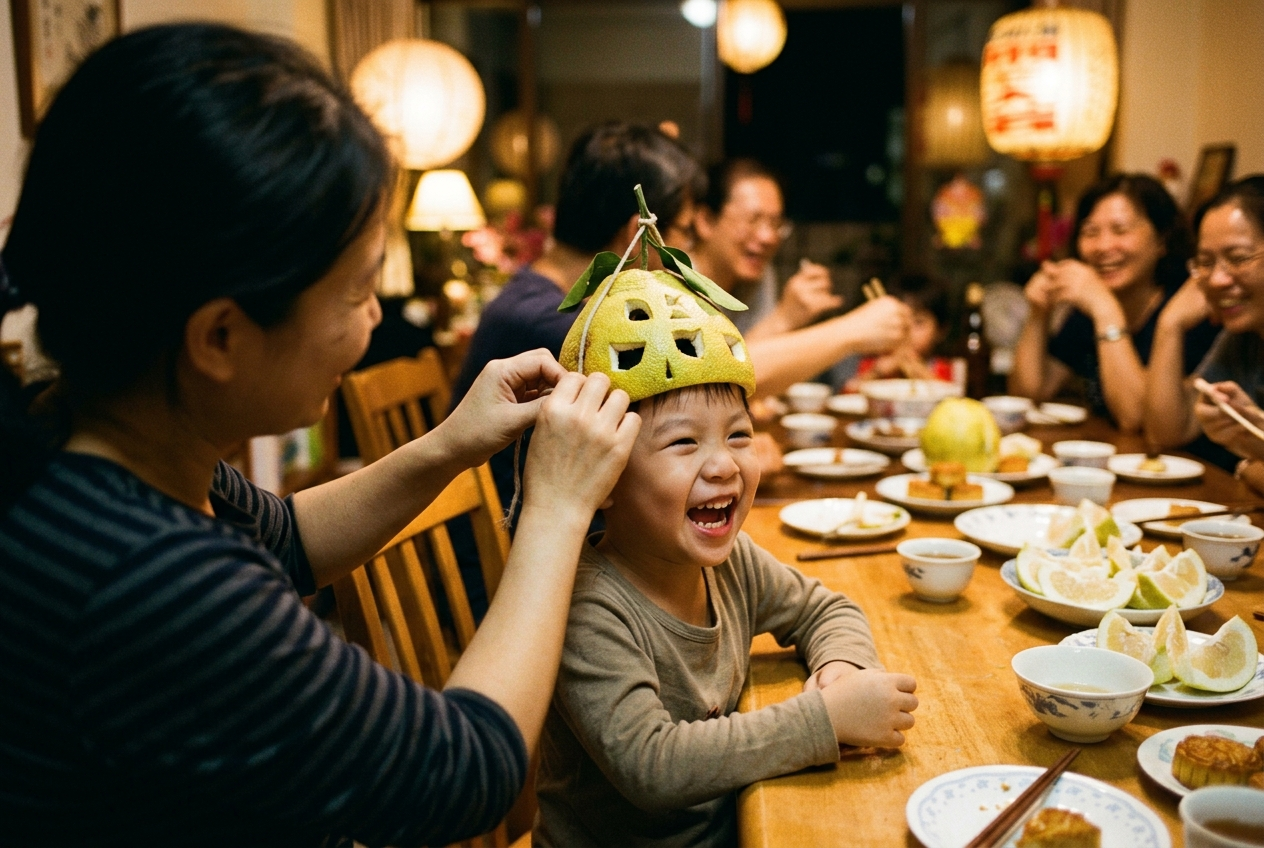
Next to the grill and the mooncakes sits the third fixture: the pomelo, 柚子, a giant thick-skinned citrus that comes into season right on cue. Peeling one is a small ceremony, and the reason it belongs to this festival is partly a pun — 柚 (pomelo) sounds like 佑, to protect or bless — and partly that the fruit is simply ripe and good in late September. There is also the beloved, faintly ridiculous tradition of carving the thick rind into a little hat and setting it on a child’s head. No one is quite sure why it started. Every family does it anyway, and every year there are photographs.
Then there is the moon itself, and the stories layered onto it. The festival’s oldest heart is the legend of Chang’e, 嫦娥, the woman who swallowed an elixir of immortality and drifted up to live on the moon, where she remains with a jade rabbit forever pounding herbs beside her. Look at a full moon with the story in mind and the shadows do start to resemble a rabbit. There is also the folk tale that mooncakes once smuggled a rebellion — secret notes baked inside them to coordinate an uprising against Mongol rule at the end of the Yuan dynasty. Historians are sceptical, but it is a good story, and it is why the cake carries a faint whiff of quiet resistance under all that sweetness.
How to spend the evening, if you are here
If you find yourself in Taiwan for Mid-Autumn, the best thing that can happen is an invitation to someone’s grill; the second best is to bring your own drinks and a box of mooncakes and offer to help fan the coals. Taiwanese hospitality will do the rest. If you would rather keep to yourself, the riverside parks are the move — Dadaocheng Wharf and the Tamsui waterfront in Taipei, the banks of the Love River in Kaohsiung, any stretch of open sky where families spread out with their grills and the moon has room to show off.
A few practical notes. Buy mooncakes early; the good bakeries sell out of their gift boxes and the department-store counters get chaotic in the final week. If you are visiting a Taiwanese home, a nice box of mooncakes or a good pomelo is the correct gift, and it will be met with the usual warm protest before it is accepted. Expect the whole neighbourhood to smell like charcoal for days, expect to be handed food constantly, and expect nobody to rush. The festival runs on the opposite of hurry.
A quieter reading
Underneath the smoke and the sugar, Mid-Autumn is a festival about being in the same place as the people you love, and, when you cannot be, about looking at the same moon they are looking at. The old poems return to this again and again: the moon as the one thing everyone shares, no matter how far apart. That is why the word that hovers over the whole night is 團圓 — reunion, roundness, the family circle closed for an evening. The mooncake is round, the moon is round, the family gathers in a round. The barbecue is loud and the mooncakes are too sweet and a child is wearing fruit on his head, and somehow all of it points at the same gentle idea: come home if you can, and if you cannot, look up. Someone you love is looking at the same moon.