Paris Fashion Week offered a striking contrast this season: extravagant runway productions, gold, celebrity spectacle, exposed bodies and couture-level craftsmanship unfolding against a much less glamorous commercial backdrop.
As luxury groups contend with weaker customer recruitment and growing resistance to repeated price increases, the season pointed to a new question for the industry: Can luxury make the product itself look sufficiently valuable to justify the price?
Paris demonstrated that fashion houses can still generate enormous attention. Converting that attention into sustained willingness to pay is the harder challenge.
Paris Remains Exceptionally Good at Creating Desire
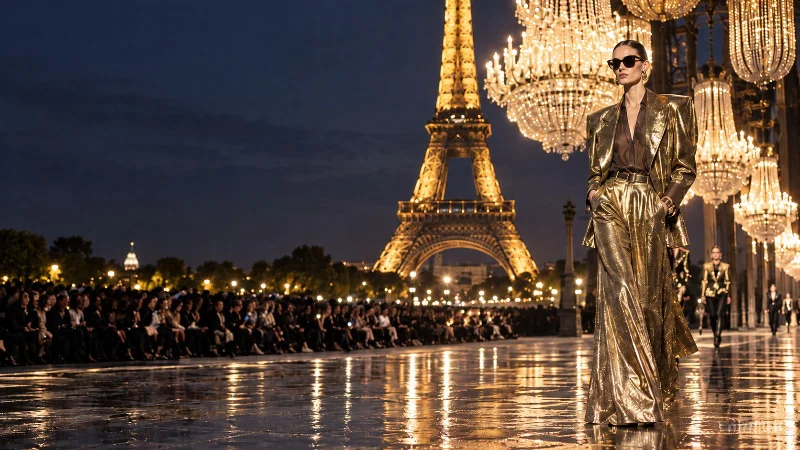
No house illustrated that more clearly than Saint Laurent. Anthony Vaccarello marked his 10th anniversary at the brand with an outdoor show at Paris’s Trocadéro, framed by the Eiffel Tower, glossy black flooring and monumental chandeliers.
Catherine Deneuve, Kate Moss, Hailey Bieber and Rami Malek were among the guests as gold dominated the collection through metallic safari jackets, crinkled trenches, lace cocktail dresses, brocade tailoring and stilettos balanced on serpent-shaped heels.
The finale moved into black, reversing Yves Saint Laurent’s all-gold closing sequence from 1991.
The show also carried a retrospective quality that fueled speculation about Vaccarello’s future, although no departure was announced. The designer did not give his customary interviews.
That uncertainty comes as luxury groups increasingly rely on creative leadership to generate growth after years of expansion and price increases.
Saint Laurent is particularly significant for Kering as its second-largest fashion house and one of the group’s businesses showing renewed momentum. Kering said the brand returned to growth in the first half of 2026, helped by North America and Western Europe, while Gucci revenue remained down 5 percent on a comparable basis.
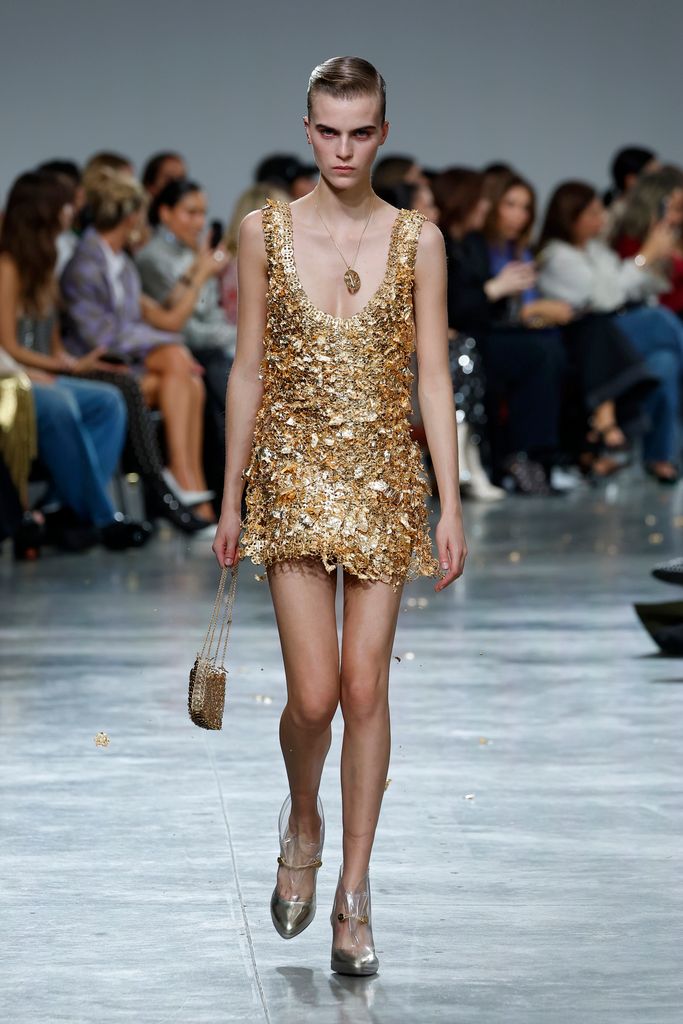
“Luxury loses pricing power when the customer can no longer see the difference between a higher price and a better product. Paris Fashion Week 2027 suggests the next contest will be fought through craft, coherence and credible product value,” said Prof. Dr. Amarendra Bhushan Dhiraj, CEO of CEOWORLD Magazine, economist, investment strategist and bestselling author.
Craft Becomes Part of the Pricing Argument
The most commercially relevant development in Paris may have been less about spectacle than about bringing couture techniques into everyday clothing.
At Balenciaga, Pierpaolo Piccioli used rows of stitching on a white shirt to shape the waist and create a peplum, applying a similar approach to a T-shirt. Jeans were cut on the bias to alter the way the fabric fell.
The idea was to bring elements of couture into the everyday wardrobe rather than confine craftsmanship to highly formal pieces.
Loewe pursued a related proposition through supple leather, glass-bead dresses and garments designed around wearability. In a market where consumers are questioning the justification for luxury prices, visible construction, materials and finishing can become part of the product’s value proposition.
The shift comes after substantial price inflation across luxury. Prices rose about 20 percent over two years, according to Bain figures cited in the reporting, while Reuters reported that repeated increases had alienated roughly 60 million former luxury consumers since 2022.
The lesson is not necessarily that luxury must become cheaper. Rather, the gap between price and perceived value has become increasingly important.
Excess, Exposure and Wearability
Other designers pursued desire through sensuality, texture and movement.
At Chloé, Chemena Kamali combined broderie anglaise, lace, tassels and embellished surfaces with vivid rainwear and oversized fishermen’s hats. The peplum also appeared elsewhere during the week, reinforcing a broader return to visibly constructed waists and sculptural femininity.
Stella McCartney took a different route. Jennifer Lopez watched from beneath an umbrella in the rain-soaked gardens of the British ambassador’s residence as fluid tailoring, coral-inspired knits and dolphin motifs carried an ocean-conservation message. David Attenborough’s voice was incorporated into the show’s environmental framing.
At Issey Miyake, Satoshi Kondo explored the Japanese concept of ma, or the space between body and clothing. Large pieces of fabric, live piano and garments that expanded and shifted with movement turned negative space into a central design element.
Tom Ford, meanwhile, pushed underwear-as-outerwear to an extreme. Under Haider Ackermann, sharp tailoring appeared alongside bare torsos, fishnet, minimal swimwear and silk robes. One look paired a pale pink thong and sweater with a vicuña coat that can cost more than $33,000.
Balmain, Rick Owens and Courrèges explored similar territory through corsetry, garters, tulle, cage structures and body exposure.
This renewed emphasis on extremes also serves a commercial purpose. When consumers feel they have seen the same handbags, logos and familiar product lines repeatedly, dramatic design can restore a sense of novelty and emotional intensity.
Luxury’s Cultural Contradiction
At Place de la République, Matières Fécales staged “The 99 Percent,” combining sari-influenced draping, shredded denim, masked-demonstrator imagery and a finale featuring a gold gown and slumped figures in suits. Rihanna’s attendance further increased the show’s visibility.
The collection sought to connect fashion with marginalised communities and public space, while its title highlighted a broader contradiction within luxury: brands increasingly seek cultural relevance among mass audiences even though their products remain financially inaccessible to most of those audiences.
Cultural visibility can be commercially valuable even when most people watching a show will never become customers. But attention alone cannot replace product quality, repeat purchases or sustainable margins.
The Broader Business Implications
Paris’s luxury reset offers several lessons for executives.
Pricing power increasingly depends on product value. Premium companies cannot rely indefinitely on higher prices without demonstrating what customers receive in return.
Creative leadership has become a capital-allocation issue. Designer appointments affect product strategy, marketing, inventory, store performance and ultimately brand valuation. Frequent creative changes can generate publicity, but they can also create execution risk and disrupt continuity.
Customer recruitment matters alongside top-end spending. Wealthy clients remain essential, but losing aspirational consumers narrows the industry’s future customer pipeline. Beauty’s relative resilience demonstrates the value of lower-priced ways to participate in luxury without abandoning prestige.
As Despina Wilson, Executive President of CEO ATELIER, put it: “The strongest luxury products do not need price alone to signal exclusivity; material, construction and wearability should make value visible.”
Executive Takeaways
What changed: Paris increasingly positioned craftsmanship, construction and recognizable design codes alongside spectacle as the justification for luxury pricing.
Why it matters: Slower customer recruitment and resistance to repeated price increases are forcing brands to demonstrate value more clearly.
What leaders should monitor: Full-price sell-through, new-customer recruitment, repeat purchases, product-level margins and the commercial impact of creative-director changes—not social-media attention alone.
Paris Fashion Week showed that luxury has not lost its ability to create desire. The more difficult test is whether that desire can become durable demand without relying on price increases that outpace perceived value.
Over the next 12 to 24 months, the critical question will be whether brands investing in craftsmanship, distinctive design and wearable innovation can translate those qualities into stronger customer retention and growth. Luxury’s next phase may depend less on how loudly a brand commands attention and more on whether customers believe the product has earned its price.