More than 300 historic Russian and European works of art and design from the vaults of renowned New York gallery A La Vieille Russie will go under the hammer at Sotheby’s this December.
Titled “From the Vaults of A La Vieille Russie,” the sale will draw from the holdings of the family-owned gallery, widely regarded as a leading authority on Fabergé, Russian art, European decorative arts and antique jewelry.
The live auction is scheduled for December 16 in New York, with an accompanying online sale running from December 3 through 17. The 300 lots are collectively expected to generate more than $15 million.
A Remarkable Collection of Russian Art
The sale will span a broad range of decorative and fine arts, including historic Fabergé creations, Russian works of art, European gold boxes, paintings, icons, porcelain and silver.
Imperial objects and Swiss mechanical works will also be offered, providing collectors with an unusually broad cross-section of European craftsmanship and collecting history.
The breadth of the auction reflects the depth of A La Vieille Russie’s holdings and its long-standing role in preserving and promoting works associated with Russian and European decorative arts.
175 Years of A La Vieille Russie
The auction comes as A La Vieille Russie celebrates its 175th anniversary.
The New York gallery has remained family-owned and has built a reputation through generations of scholarship and connoisseurship. Its expertise and collections have helped shape the holdings of private collectors as well as major museums.
By bringing works from its vaults to Sotheby’s, the sale offers collectors an opportunity to acquire pieces connected not only to important artistic traditions but also to the history of one of the world’s most established specialist galleries.

A La Vieille Russie
Mark Schaffer, a principal at the firm, said ALVR is emptying its vaults as it transitions to placing greater emphasis on antique and period jewelry, while continuing to offer decorative works of art, including works by Fabergé. Sotheby’s said the selection reflects this evolution.
“It felt like an appropriate moment to consider our collection. Many of the remarkable works we have cared for and studied for decades, in some cases, generations, and we believe they should now have the opportunity to pass into the hands of a new generation of collectors,” Schaffer said via email. “Presenting the works together also allows people to see the relationships among them and the history, scholarship and connoisseurship that have defined the gallery over generations. This auction offers the international reach to present them properly to collectors and institutions around the world.”

Sotheby’s
A rare Fabergé miniature sedan chair made from varicolor gold, rock crystal, mother-of-pearl and guilloché enamel is set to lead an upcoming Sotheby’s auction, with an estimate of more than $1 million.
The piece is particularly notable for its provenance and rarity. According to Sotheby’s, it is one of only six miniature Fabergé sedan chairs known to have survived.
It will also return to the auction market for the first time since it was acquired more than a century ago.
A Rothschild Provenance
The sedan chair was first documented in the collection of Leopold Rothschild, the son of Baron Lionel de Rothschild.
Records from The Rothschild Archive show that Leopold purchased the model in 1910 as a gift for his brother Alfred, paying £146 for the piece.
Designed in the Louis XV style, the miniature was executed by a Fabergé head workmaster, combining the firm’s celebrated decorative techniques with an exceptionally intricate scale.
Its century-long history within the Rothschild family adds another layer of significance to an object already distinguished by its rarity and materials.
Fabergé’s Botanical Masterpieces
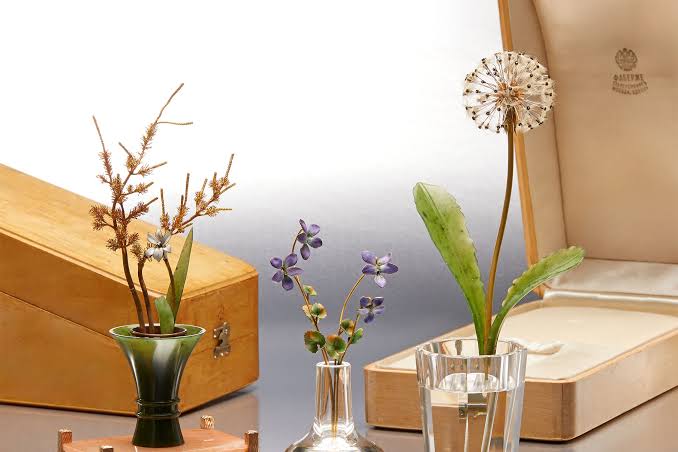
The auction will also feature examples of Fabergé’s renowned lapidary craftsmanship, including three flower studies.
Flowers held a special place within the Fabergé tradition, with members of the Imperial family among the firm’s most devoted collectors of these botanical creations. According to Sotheby’s, the Imperial family frequently exchanged Fabergé flowers as gifts.
Together, the sedan chair and floral studies highlight the extraordinary range of materials and craftsmanship associated with Fabergé, from miniature decorative objects to lifelike interpretations of nature.

Sotheby’s
A highlight is a gold, enamel and rock crystal flower study of violets purchased in 1901 by Emperor Nicholas II and his wife, Empress Alexandra Feodorovna. It is estimated at $300,000-$500,000.

Sotheby’s
A gold, hardstone and enamel study of a Japanese garden, offered in its original box with exhibition history, is also estimated at $300,000-$500,000.

Sotheby’s
A gold and nephrite dandelion, estimated at $250,000-$350,000.

Sotheby’s
Other Fabergé works include a silver-gilt beaker that unites two celebrated names in Russian enameling: Carl Fabergé and enamelist Feodor Rückert. Rückert gave the beaker to Fabergé in 1912 to commemorate the 25th anniversary of Fabergé’s Moscow branch. It is inscribed, “XXV. To the highly esteemed Carl Gustavovich, in gratitude. F. I. Rückert. 1912.” It is estimated at $180,000-$250,000.

Sotheby’s
A rare sculptural varicolor gold loving cup demonstrates Fabergé’s goldsmithing expertise. Inspired by the use of colored gold in 18th-century French goldwork, the vessel is engraved with alternating feather-form lozenges and raised on a pair of stepped feet. Its estimate is $70,000-$100,000.
The sale includes several objects with Imperial Russian provenance, including a silver-gilt samovar made in 1866 by the English silversmiths Nicholls & Plincke. The handle of its spout bears the cypher of Grand Duke Alexander Alexandrovich, the future Emperor Alexander III.

Sotheby’s
The samovar dates to 1866, the year Alexander became heir to the Russian throne and married Princess Dagmar of Denmark, the future Empress Maria Feodorovna. It was included in the 1936 exhibition “The Schaffer Collection of Authentic Imperial Russian Art Treasures,” held at ALVR’s original New York gallery at Rockefeller Center. Sotheby’s calls it one of the most important works in the gallery’s collection. Its estimate is $300,000-$500,000.
Schaffer said it is the item he finds most difficult to part with.
“It not only is magnificent for its beauty, Imperial provenance and significance, but also has a deep emotional connection to the gallery and our family,” he said. “It was included in our 1936 exhibition at our Rockefeller Center gallery and has remained with us ever since. Parting with an object that has been part of our history for so long is especially meaningful.”
The collection also includes paintings and works on paper by leading Russian painters of the late 19th and 20th centuries, including Isaak Levitan, Ivan Shishkin, Viktor Vasnetsov and Ivan Aivazovsky.

Sotheby’s
Among the highlights is Aivazovsky’s 1896 painting of the coast of his native Crimea. The artist painted the Bay of Yalta and its surrounding coastline in every decade of his 60-year career. The painting in the auction was completed when Aivazovsky was 79 years old.
It left Russia before or shortly after the 1917 Bolshevik Revolution and had entered a Norwegian collection by the 1920s, bearing a label from Oslo framer and dealer Blomqvist. It has been in the ALVR collection for decades. “The Bay of Yalta” will be offered at auction for the first time, with an estimate of $600,000-$800,000.

Sotheby’s
An important example of Russian gold and enamel work from the 19th and early 20th centuries is a jeweled, enameled and nielloed gold icon of the Mother of God of Vladimir, dating to circa 1650. Estimated at more than $800,000, the icon’s painting and goldsmithing are attributed to a small group of 17th-century craftsmen known as the Tsar’s Icon Painters, or Tsarskie Ikonopistzi. The icon was formerly owned by the family of the Counts Tolstoy, one of the oldest families of the Russian nobility.
The collection also features examples of Swiss watchmaking and automata.

Sotheby’s
Sotheby’s describes a life-sized Siberian mouse cast in pearls, gold and enamel as perhaps the most active and realistic of the small animal automata. The mouse darts forward, twirls and then scampers off in a different direction. Only nine automaton mice of this type are believed to have survived, Sotheby’s said. The piece has been in the ALVR collection for more than 60 years and is estimated at $250,000-$350,000.

Sotheby’s
The collection also includes rare 18th-century gold boxes, including a gold and enamel box by Parisian jeweler Jean Formey, which was formerly in the collection of mining magnate Sir Alfred Chester Beatty. Its estimate is $200,000-$300,000.
A La Vieille Russie
A La Vieille Russie has a history spanning 175 years and surviving wars and political upheaval in the first half of the 20th century. It was founded as an antiques business in Kyiv in 1851 by Jacob Zolotnitsky and expanded under his son, Abraham, to two locations in the city by the end of the century.
Abraham’s son, Jacques Zolotnitsky, and his nephew, Léon Grinberg, fled Kyiv in 1919 amid the political upheaval surrounding World War I and the Bolshevik Revolution. They moved the business to Paris by 1920-21, where the gallery became a trading center and intellectual gathering place for the city’s Russian émigré community. It also attracted entertainers, artists, business leaders and royalty. Queen Marie of Romania, the Duke and Duchess of Windsor, Anna Pavlova, Salvador Dalí, Sergei Diaghilev and Marlene Dietrich were among the visitors to the Paris gallery.

A La Vieille Russie
The first New York store, named Russian Imperial Treasures, opened at Rockefeller Center in 1933 under Alexander Schaffer, who had fled political upheaval in his native Hungary. In 1941, after helping Jacques and Léon secure passage from war-torn Europe, he united the two businesses as A La Vieille Russie at 785 Fifth Avenue in New York.
In 1961, A La Vieille Russie relocated to the corner of Fifth Avenue and 59th Street, where it remained for 56 years. Today, it is located at 745 Fifth Avenue under the direction of brothers Paul and Peter Schaffer and Paul’s son, Mark Schaffer.
The New York gallery is credited with playing a central role in building many major American Fabergé collections, including the private collections of Malcolm Forbes, Marjorie Merriweather Post, Lillian Thomas Pratt, India Early Minshall and Matilda Geddings Gray. These collections are now housed in museums throughout the country.