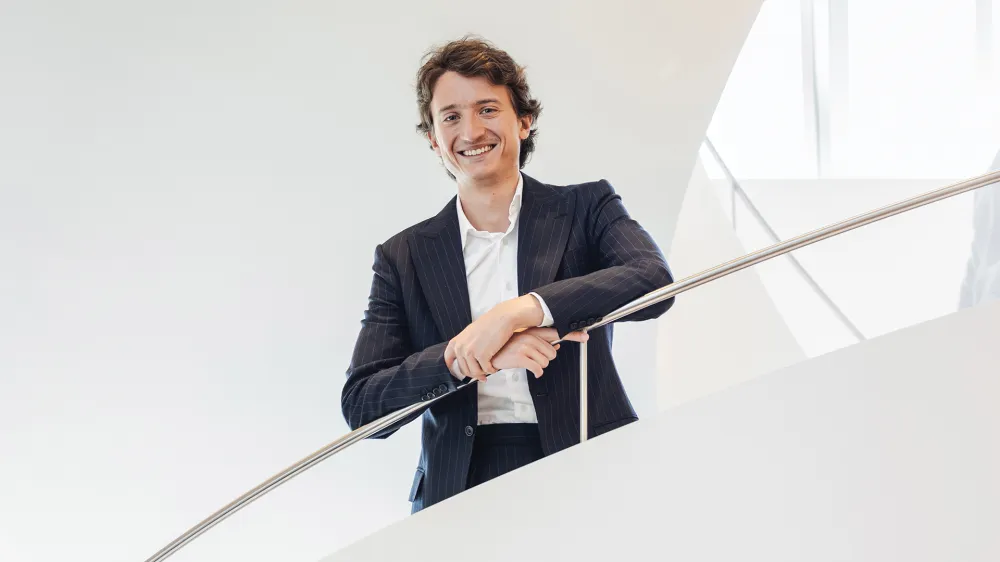
At just 28, the executive has reshaped Louis Vuitton’s watch division, earned the attention of discerning collectors, and helped establish the fashion house as an increasingly influential force in high horology. His ambitions now extend well beyond watches.
When Jean Arnault took charge of Louis Vuitton’s watchmaking division in 2021, he was only 22. At an age when many young professionals are still establishing their careers, he had been handed a formidable assignment: change the perception of Louis Vuitton watches and convince serious collectors that the luxury fashion house deserved a place in the world of fine watchmaking.
The challenge was significant, but Arnault brought an impressive academic background to the role. Before joining the business, he earned a master’s degree in mechanical engineering from Imperial College London, followed by another in financial mathematics at the Massachusetts Institute of Technology. As the youngest son of LVMH chairman and CEO Bernard Arnault, his appointment was part of a broader pattern of the family’s involvement across the luxury group. Yet his responsibility was particularly demanding.
Since taking the position, he has reorganized the watch division, sharpened its design identity and invested heavily in traditional craftsmanship and sophisticated mechanical movements. The results are beginning to change how collectors view Louis Vuitton.
Turning untapped expertise into a watchmaking advantage
Although Louis Vuitton’s watch division represents less than 1 percent of the company’s overall revenue, according to a report by Morgan Stanley and LuxeConsult, Arnault has access to the resources of one of the world’s largest luxury groups.
He also inherited an important technical advantage: La Fabrique du Temps, the Geneva-based movement specialist and watchmaking atelier acquired by Louis Vuitton in 2011. Its master watchmakers, Michel Navas and Enrico Barbasini, had previously developed their expertise at prestigious houses including Patek Philippe, Audemars Piguet, Gérald Genta and Franck Muller.
Arnault quickly recognized that the talent and technical capabilities were already there. What was missing was a strategy that would allow the company to fully use them.
He regularly visits the manufacture, sometimes once a week, and takes a hands-on interest in its work. His enthusiasm for mechanics is evident whenever he discusses the smallest details of a movement or the techniques involved in finishing a watch.
That interest goes back further than his appointment. At 20, he completed an internship at the manufacture, rotating through different departments and learning about the work of engineers, designers and watchmakers. He even dismantled and reassembled a watch.
Navas was impressed by how much Arnault already knew about the industry. He recalls that the young executive could identify specific models and technical references, including complicated Patek Philippe watches. For someone so early in his career, his knowledge was unusually deep.
Collectors have also noticed his involvement. Philadelphia-based collector Drew Coblitz, who owns a Louis Vuitton Tambour, says Arnault makes an effort to understand every part of the operation rather than simply managing from the top. That personal commitment, he believes, gives the watches a stronger identity and distinguishes the current direction from the company’s earlier approach.

Daniel Roth Tourbillon Souscription, Extra Plat Skeleton, and Extra Plat Souscription models.Niels Ackermann
A new philosophy: fewer watches, better craftsmanship
Arnault understood that Louis Vuitton could not establish credibility in high horology simply by relying on its famous name. The watches had to demonstrate genuine technical and artistic quality.
A major part of his strategy was therefore to reduce production and concentrate on craftsmanship. The company eliminated approximately 80 percent of its existing collection, choosing to focus on fewer pieces with higher standards of design, finishing and technical execution.
The decision required a substantial change in the way the division operated. Rather than producing watches at the scale expected of a major luxury house, Louis Vuitton began adopting an approach closer to that of an independent watchmaker.
The transformation also required significant investment in vertical integration. The company brought more of its production capabilities and component manufacturing in-house, reducing its dependence on outside suppliers.
One notable example is the Spin Time, a signature Louis Vuitton complication. Earlier versions used an ETA base movement beneath the mechanism developed by La Fabrique du Temps. In 2025, the collection introduced a movement developed entirely in-house.
The manufacture itself has become more specialized, with operations divided into three areas: La Fabrique des Arts, La Fabrique des Mouvements and La Fabrique des Boîtiers. These departments operate across two buildings and cover artistic crafts, movement development and case production.
The expanded capabilities allow Louis Vuitton to pursue increasingly specialized techniques, including enameling, engraving and advanced machining.
Arnault says the decision to change direction was reinforced by conversations with Navas and Barbasini shortly after he arrived. Both explained that the existing working structure needed improvement. Although he initially approached their recommendations cautiously, he soon became convinced that the priority had to be making exceptional watches, even if the commercial implications were less straightforward.
His philosophy reflects advice he says he received from former Louis Vuitton chairman and CEO Michael Burke, as well as his father: build a great product first, and the business will follow.

From left: A drawer of various stone samples used for dials; a meteorite sculpture has pride of place in the stone department where dial material is sourced.Niels Ackermann
Recruiting Switzerland’s finest artisans
The strategy has involved bringing highly specialized watchmaking talent into the company. During a visit to the manufacture, the range of expertise on display was striking.
One employee has spent 27 years specializing in making screws, a task that might appear insignificant to someone outside the industry but requires extraordinary precision. Arnault describes him as one of Switzerland’s finest specialists in the field.
Other employees have arrived from respected watchmaking houses. A guilloché artisan with two decades of experience at Breguet works on intricate dial patterns, where even small vibrations can interfere with the process. An enameler recruited from Patek Philippe creates detailed miniature scenes using a brush made with a single squirrel hair.
In the engineering department, a former Jaeger-LeCoultre employee says he moved to Louis Vuitton because the projects offered opportunities to explore more ambitious ideas.
The atmosphere suggests that the company is trying to build a destination for craftspeople who want to work on unusual and technically challenging pieces. Arnault is frequently seen speaking directly with employees, examining their work and discussing the details of individual projects.

A watchmaker carefully hand-assembles a movement inside the manufacture. Niels Ackermann
Reviving two legendary watchmaking names
One of the clearest demonstrations of Arnault’s ambitions came through the revival of Daniel Roth and Gérald Genta, two respected names in independent watchmaking that are now under the stewardship of La Fabrique du Temps.
The Daniel Roth revival began in March 2023 with the Tourbillon Souscription. Rather than dramatically reinventing the brand, Louis Vuitton returned to the distinctive double-ellipse case and tourbillon architecture that helped establish Roth’s reputation.
Limited to 20 yellow-gold examples, the watch featured traditional hand-finishing and a newly developed La Fabrique du Temps movement, the calibre DR001.
Arnault deliberately chose a limited subscription model instead of producing a large quantity of watches before confirming demand. Under this arrangement, collectors pay upfront to support production and settle the remaining balance when the watch is delivered.
He wanted to build the brand gradually and organically, rather than rely on the financial strength of LVMH to manufacture thousands of watches without knowing whether the market would embrace them.
The Gérald Genta revival followed in June 2023 with a Mickey Mouse Minute Repeater created for the Only Watch charity. Inspired by a highly collectible earlier design, the watch combined jumping hours with retrograde minutes.
Both projects helped demonstrate that Louis Vuitton intended to approach these historic names with respect for their identities and watchmaking heritage.
Collectors have responded positively. Miami-based entrepreneur and entertainment executive Lex Borrero, who owns the Daniel Roth Extra Plat Skeleton, believes the brand’s direction has the potential to build considerable momentum.
Arnault, however, says the goal is not simply to reproduce historical designs. He wants Daniel Roth to develop new complications and technical ideas while retaining the visual character that makes the watches recognizable. He compares the approach to the Porsche 911: the design remains familiar, but the engineering continues to evolve.

A guilloché expert operates an antique engine-turning machine to decorate a dial. The work is so precarious even the thump of a heel or a passing car in the street can disturb his work.Niels Ackermann
The Tambour becomes a serious contender
In July 2023, Louis Vuitton introduced a substantially redesigned Tambour, marking another major step in its watchmaking transformation.
The new model featured an integrated bracelet, a slimmer and more refined profile, and the in-house automatic LFT023 calibre. The movement included a 22-karat rose-gold microrotor, micro-blasted bridges with polished and chamfered edges, a circular-grained mainplate and transparent rubies.
It was a considerable improvement in both appearance and technical execution. Yet Arnault admits that the initial reaction from some collector friends was more enthusiastic in conversation than in purchasing behavior. Many praised the watch, tried it on and posed for photographs, but relatively few actually bought one.
That response highlighted the challenge facing Louis Vuitton: creating a technically impressive watch was only part of the task. The company also had to overcome the perception that a fashion brand could not be a serious watchmaker.
An unexpected collaboration puts the industry on notice
Louis Vuitton soon found another way to demonstrate its intentions.
In October 2023, the company announced a collaboration with Akrivia, the independent Geneva atelier founded by Rexhep Rexhepi, one of the most closely watched young figures in contemporary independent watchmaking.
The partnership surprised the industry and gave Louis Vuitton an important endorsement from a respected independent watchmaker.
The resulting LVRR-01 Chronographe à Sonnerie was limited to 10 examples, each priced at approximately $497,000. Proceeds supported the LVMH Watch Prize for Independent Creatives, which provides winning watchmakers with €150,000 in funding and a year of mentorship from La Fabrique du Temps.
The initiative reflects a broader ambition. Arnault wants Louis Vuitton to contribute to the future of mechanical watchmaking, not simply expand its own commercial position.
He believes independent watchmakers play an essential role in keeping the industry innovative. Without adequate support, talented creators may struggle to sustain their businesses and preserve their craft.
Further collaborations followed with Voutilainen and De Bethune. Arnault says the company plans to limit the total number of collaborations to five, while continuing the annual independent watchmaking competition.
He has also indicated that LVMH could consider acquiring independent watchmaking businesses, although he would approach such a decision carefully. The objective, he says, would be to protect a distinctive vision or preserve specialized expertise—not to turn a small independent operation into a mass-production business.

An expert enameler mixes powder in a mortar and pestle to prepare the material for a dial.Niels Ackermann
Winning over collectors who once dismissed the brand
Despite the progress, Louis Vuitton still faces a perception problem among some traditional collectors.
The challenge is not unique to the company. Fashion houses such as Hermès and Chanel have also had to contend with the assumption that a brand known primarily for clothing, accessories or handbags cannot compete with established watchmakers.
William Massena, a longtime collector and founder of Massena LAB, recalls that Arnault’s appointment initially prompted skepticism. Some observers viewed the move as a wealthy heir being handed an expensive hobby. Others questioned whether he genuinely understood watches or would remain committed to the division.
Massena says those doubts have increasingly been answered by Arnault’s knowledge, willingness to learn and visible passion for the craft.
For some collectors, however, the name on the dial remains a difficult obstacle.
Borrero is a good example. Although he already bought other Louis Vuitton products, he had never considered its watches seriously. Earlier designs struck him as jewelry pieces rather than watches that belonged in his collection.
His opinion changed after attending LVMH Watch Week in 2024 and learning more about the company’s technical direction. After meeting Navas in Miami, he decided to take a chance on the Tambour Convergence jump-hour watch. He became its first global delivery recipient and later purchased the Tambour Convergence Guilloché introduced in 2026.
Other collectors remain more conflicted. One Chicago-based buyer purchased a limited-edition 18-karat rose-gold Escale because he wanted to experience the watch firsthand rather than judge it from a distance. He was impressed by its construction, particularly the Escale Minute Repeater, whose activation slide is discreetly integrated into the case.
Yet he admits that the Louis Vuitton name still presents a psychological barrier. In his view, the technical quality is strong enough that another brand name on the dial might attract less resistance.
That tension illustrates the scale of the task Arnault has taken on. The watches must not only meet the expectations of serious collectors; they must also persuade buyers to reconsider decades of assumptions about what Louis Vuitton represents.

From left: Artisans are equipped with Louis Vuitton armrests; a craftsman assembles a piece of the Tambour Taiko Arty Automata.Niels Ackermann
Building relationships beyond the showroom
Arnault recognizes that credibility cannot be established through product launches alone. Since taking charge, he has made a point of meeting collectors personally and explaining the long-term direction of the business.
In 2023, Justin Reis, chairman of the Philadelphia-based 1916 Company, hosted him at two intimate events in New York and Los Angeles. Each gathering brought together approximately 20 collectors, giving Arnault an opportunity to discuss the watches and answer questions about the company’s ambitions.
Reis says Arnault understood early that he would have to demonstrate his commitment in person. The credibility Louis Vuitton wanted could not simply be purchased through marketing or the power of its parent company.
The personal approach extends to individual clients. Arnault sometimes delivers watches himself, particularly when a piece has involved an unusually complex or meaningful commission.
One recent example involved a bespoke pocket watch that brought its recipient to tears. It was the largest purchase she had ever made, and the emotional response stayed with Arnault.
The watch had taken the work of approximately 30 people from beginning to end. One enameler had devoted countless hours to its dial, listening to music by French pianist Sofiane Pamart while working on the intricate design. The client later told Arnault that hearing the same music reminded her of the watch.
For him, that story captures the value of the work beyond the finished object. The artisans become personally invested in the pieces they create, while clients develop a connection to the people and processes behind them.
Arnault also understands that collector confidence depends on consistency. Someone spending $20,000, $30,000 or $50,000 on a watch wants reassurance that the company will not abandon its direction a few years later. He says Louis Vuitton is committed to maintaining its watchmaking strategy for at least the next decade.
A bigger role across LVMH
There are signs that the strategy is beginning to deliver. Arnault says some collectors who once praised the watches without purchasing them have started buying pieces over the past 12 to 18 months.
For him, that is the most meaningful endorsement. Compliments are welcome, but actual purchases demonstrate that collectors are prepared to put their confidence—and money—behind the company’s work.
His responsibilities are also growing. In addition to leading Louis Vuitton’s watchmaking ambitions, Arnault’s remit now includes oversight of Hublot and Zenith. There is also speculation that he could become involved in another area closely associated with Louis Vuitton: its celebrated trunk-making business.
The possibility seems fitting. During one meeting, Arnault recalls encountering a collector who enthusiastically praised the Spin Time watch he was wearing before adding that he had not realized Louis Vuitton also made beautiful trunks.
It was a reminder that even as Arnault works to change the perception of the company’s watches, the broader Louis Vuitton identity continues to offer opportunities.
At 28, he has already overseen a major transformation of a watch division that once struggled to command the respect of traditional collectors. The next stage will require patience, consistency and the ability to keep delivering exceptional products.
For Arnault, the ambition is not simply to make Louis Vuitton watches more popular. It is to establish a lasting place for the house in serious horology—and to use its influence to help shape the future of the watchmaking industry.