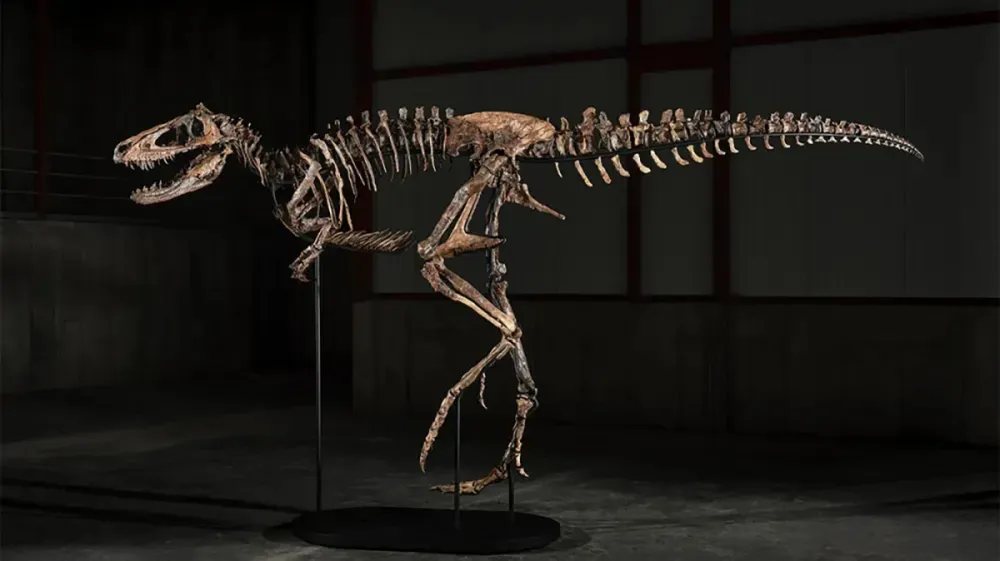
A rare dinosaur skeleton named Jodi has sold for $47.3 million, including fees, at Sotheby’s New York, making it one of the most expensive prehistoric fossils ever auctioned.
The approximately 67-million-year-old Nanotyrannus skeleton sold on Tuesday for more than five times its high estimate of $9 million. The winning bid reached $40.5 million before fees, putting the fossil among the most valuable dinosaur specimens ever sold.
The result follows Sotheby’s July sale of “Gus,” a Tyrannosaurus rex skeleton that brought in a record $50.1 million. That auction surpassed the $44.6 million paid for the Stegosaurus fossil “Apex” in 2024. Although Jodi is smaller than these headline-making specimens and lacks the fame of a T. rex, its sale came close to the current auction record.
A Rare Discovery From Montana
Jodi measures nearly 20 feet long and was discovered in Montana’s Hell Creek Formation in 2019 by rancher Jodi Pierson, who gave the fossil its name.
According to Sotheby’s, the skeleton is one of only three known Nanotyrannus specimens. It contains 191 fossil bone elements, including a nearly complete skull, adding to its significance for both collectors and researchers.
The identity of Nanotyrannus has been debated for decades. Scientists previously questioned whether the smaller predator was a distinct dinosaur or simply a juvenile Tyrannosaurus rex. A study published in Nature in 2025 supported the conclusion that Nanotyrannus was its own genus, living alongside its much larger relative.
From ‘Chomper’ to a $47.3 Million Sale
Jodi had already appeared on the art market before its record-setting auction. In 2023, the fossil was presented under the name “Chomper” and identified as a juvenile T. rex. London dealer David Aaron offered it for $20 million at Frieze Masters, but it did not sell.
Sotheby’s provenance information indicates that the current consignor acquired the specimen in 2021. By the time it returned to auction in 2026, the fossil had a new name and a different scientific classification—and ultimately sold for more than twice its earlier asking price.
Dinosaur Fossils Become Luxury Collectibles
Jodi’s sale highlights the growing market for exceptional dinosaur fossils, which increasingly compete with blue-chip artwork, rare watches and high-value sports memorabilia for wealthy collectors.
Recent auctions have demonstrated the scale of demand. Christie’s sold the T. rex skeleton “Stan” for $31.8 million in 2020, while a juvenile Ceratosaurus fossil fetched $30.5 million at Sotheby’s in 2025, despite carrying an estimate of $4 million to $6 million.
However, the rising prices have sparked concern among paleontologists, who fear that important fossils may become unaffordable for museums and disappear into private collections, potentially limiting access for scientific research.
Auction houses argue that private collectors can help finance the costly process of excavating, preserving and studying fossils. The debate continues as rare prehistoric specimens become increasingly sought-after assets in the global luxury market.