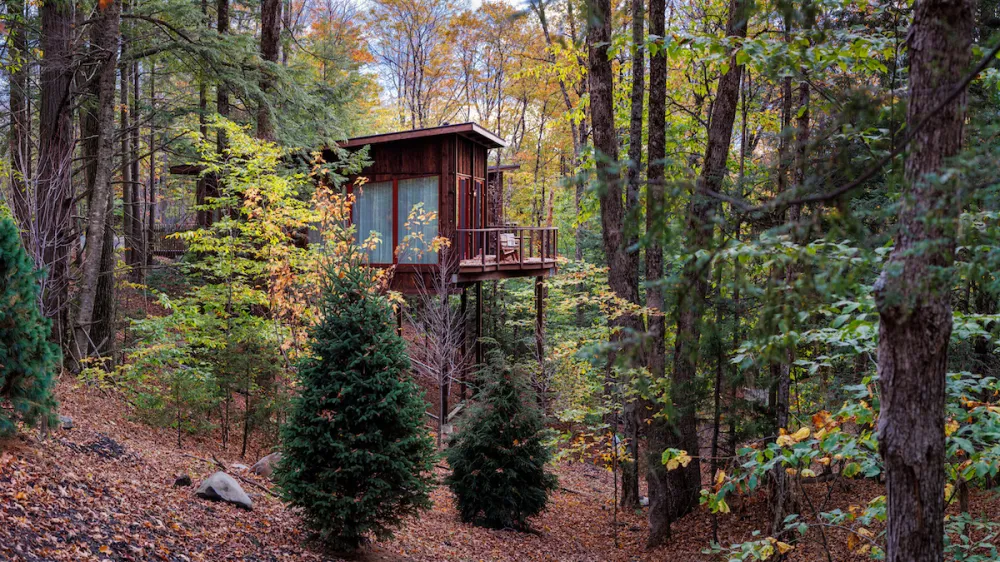
It was like someone snuck up behind me and yelled “boom!” in my ear. Despite being a human for several decades, I had never heard thunder like this, let alone been ricocheted out of bed by it at 2:45 in the morning. Disoriented, I took in the gauzy curtains surrounding my king bed, a hanging gas fireplace, the wall-to-wall wood. Oh, right: I’m in a treehouse. Actually, one of the eight new Treehouses at Twin Farms, a Relais & Chateaux retreat in Vermont’s Green Mountains. It’s a sturdy and absurdly comfortable spot to be stuck in a summer storm that might possibly become a tornado. The sky had been a hazy yellow, the same shade as the tint in my sunglasses, on my drive up to Barnard, Vermont, just east of Killington. Signs for “severe weather tonight” had been warning—in all caps—along the highway ever since I crossed into the Green Mountain State. Now I was getting to see how the state defined “severe weather.
Though safely ensconced in a high-end treehouse, nature is very much knocking on my front door—Twin Farms occupies 300 acres of private land, a mix of pine forest, fish-filled ponds, and grassy meadows, and the treehouses sit 14 to 20 feet above the ground, accessible by bridge. We are, as they say, remote. The five-hour journey here had been an exercise in winnowing: the width of the roads, the number of fellow drivers, the types of homes until they’re all uniformly wooden slats in shades of brown, like any practical alpine community. Hand-chalked signs advertise maple syrup by the quart ($15) and duck eggs off the front porch ($6). I follow Highway 12 into Woodstock (not that Woodstock), then back out to State Road for 10 miles of farmland and giant clusters of solar panels.

Twin Farms was originally the site of a 1795-era farmhouse, scooped up by Nobel Prize–winning author Sinclair Lewis for $10,000 in 1928. Per Twin Farms’ self-published almanac (fourth edition), Lewis’s bride, journalist Dorothy Thompson, “promised to marry him if he bought her a farm in Vermont with sweeping lawns, orchards, and ‘delicious air.’” Lewis delivered as promised, and the couple would go on to host “lively gatherings of poets and politicians, entertainers and entrepreneurs.” Things aren’t so different nearly a century later: A two-Michelin-key resort, Twins Farms has been drawing the well-heeled in their hiking boots since 1993, and recently grew its accommodations from 20 cottages and lodge suites—all-inclusive, adults-only—to 28 with its new Treehouses.
These 800-square-foot homes are equal parts burnished and natural, spacious with an open-plan bedroom, living room, dining room, bathroom with soaking tub, and an oversized deck that is eye-level with the birds. It’s all very wabi-sabi, celebrating simplicity and the beauty of imperfections in nature, designed by the award-winning firm Michaelis Boyd, known for its work with Soho House Group. Twin Farms makes it hard to leave your room, thunderstorm or not. A tornado didn’t manifest that night, but Mother Nature was still having a laugh; the rest of the week was choked by Canadian wildfire smoke, wafting as far south as the Jersey Shore. A simple one-mile hike around the property—there are nine miles of trails to explore—had me gasping for breath and rocking a terrible headache. What could I do in this idyll when the “delicious air” had turned noxious?

If it hadn’t been for this turn of weather events, I might not have fully appreciated the other half of the Twin Farms coin: its cultural legacy. To start, there must be thousands of books around the property—coffee-table tomes about nature, volumes of Dickens, some mystery novels for good measure—filling shelves in every guest room, up to the balcony reading nook in the main lodge. The text I picked up, A Walk in the Woods, about a modern-day freelance writer gone Thoreau for a year, posits that nature is the antithesis of culture, and that we crave one in the absence of the other. Twin Farms delivers the best of both—and if the staff could, they would likely try to move clouds and mountains to make the experience better.
Depending on the weather today, I can take part in yoga, open-play pickleball, a pasta-making class, a grilling and roasting class, an e-bike tour (there are also gravel bikes and mountain bikes), and a watercolor painting class. Tomorrow’s sessions are similar, with the addition of a fly-fishing casting lesson and a meditative stroll around the on-site labyrinth. This year, Twin Farms added intimate salons with authors, chefs, and industry leaders—the “Off Script with Twin Farms” series includes candid conversations with author Ben Mezrich, financial journalist Andrew Ross Sorkin, Sesame Workshop President Sherrie Westin, and restaurateur Danny Meyer. It’s all very civilized, reminiscent of Twin Farm’s origins as a rural retreat for the well-to-do and politically connected.
Lest I get bored, there’s also (in no particular order): guided meditation, archery, axe throwing, paddleboard yoga, picnics and sunset cocktails, a traditional Japanese onsen, a 24-hour fitness center with steam rooms, tennis, swimming, canoeing, kayaking, and fishing at Copper Pond and Silver Lake. Starting January 2027, guests can also enjoy a new 10,000-square-foot Garden House with a dry Finnish sauna, a thermal shower, hot/cold plunge pools, an indoor/outdoor mineral pool for recovery (a pool is a necessary addition here), and a tea-roasting ceremony.

The coup de grace, though, is the Chef’s Table experience, created by culinary director Nate Rich and head chef Sylvain Courbet in late 2025 as an opportunity to host a handful of guests a night in the kitchen for an immersive multi-course meal. The seasonal tasting menu is an additional cost to an otherwise robust all-inclusive stay, though the chance to hang with the chefs and not just watch them work, but pick their brains over a dozen-odd courses is the stuff of “Yes, chef!” dreams. (Fun fact: None of the chefs actually watch The Bear because it’s too much like work, and in chef Sylvain’s kitchen, there are a lot more “pleases” and “thank yous.”)
After a few rounds of wine or N/A pairings, work up the courage to get out of your seat and get up close to the action: watching sous Miles Erickson plate a perfect cut of Vermont Wagyu, or quizzing the “Professor”—my nickname for wine director Ryan Bogdan for his encyclopedic knowledge of beverages—on the best bottles of zero-proof wine. Ask as many questions as you can; they truly don’t mind. What kind of range is that? Has anyone ever been locked in the freezer? Is it weird to have us watch you work? (No, they say, shockingly.)
I spent an entire day inside a Treehouse and most of a night in a kitchen—it was a woodland adventure I won’t soon forget.